

Can you believe it? Complex circuit systems can also be "spun" into soft fibers, making it possible to weave electronic skin for robots! Meifang Zhu, Academician of the Chinese Academy of Sciences and Professor at Donghua University, and Researcher Gang Wang and their colleagues have integrated electronic devices and their interconnections into the internal structure of continuous fibers through microfluidic coded spinning, achieving simultaneous fiber formation and circuit construction so that the fiber itself becomes a circuit. While enhancing multimodal sensing, information processing, and interaction capabilities, the fibers better adapt to the complex shapes and movements of robots, opening up more possibilities for embodied intelligence applications. The related work, entitled "Programmable spinning of integrated circuit fibres", was published in Nature Electronics.
The development of embodied intelligence requires electronic systems to adapt to the complex shapes and movements of robots. Soft, bendable fibers provide a new carrier for integrating electronic functions into these structures. However, moving from individual fiber devices to functional circuits requires simultaneous solutions to material arrangement, device architecture, and electrical interconnection. How to coordinate these aspects during fiber formation is the key to advancing fiber electronics toward system integration.
To address this challenge, Gang Wang and colleagues converted circuit layouts into spinning programs through precise fluidic design. In the fiber cross-section, the flow properties of conductive, insulating, light-emitting, or semiconducting materials are regulated to form stable functional layers of different types; along the fiber length, the input of each spinning solution is modulated so that the functional layers are continuous or interrupted as designed, forming electrical interconnections between devices. This process encodes circuits with fluids, "writing" the designed material combinations and fluid-input programs into the device structures and interconnections inside the fiber. The material hierarchy, device architecture, and circuit interconnection are established together during the forming process, making the fiber itself a circuit.
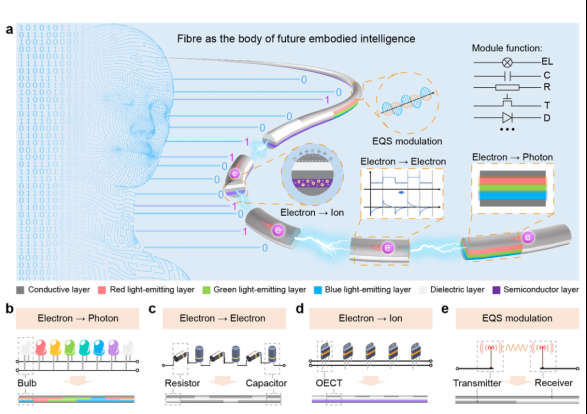
Conceptual illustration of circuit fibers.
Based on this innovative spinning platform, the team constructed modules for color electroluminescence, analog signal processing, digital logic operations, and touchless spatial sensing, and further interconnected different types of devices—transistors, resistors, and capacitors—as designed, realizing circuit functions such as tunable filter circuits and inverters within a single fiber. The research thus advances from the separate construction of multiple functional modules to circuit integration in which different devices work cooperatively within a fiber, demonstrating the ability to design and manufacture fiber circuits according to functional requirements. This provides an extensible circuit foundation for fiber electronics to further combine sensing, processing, and other functions.
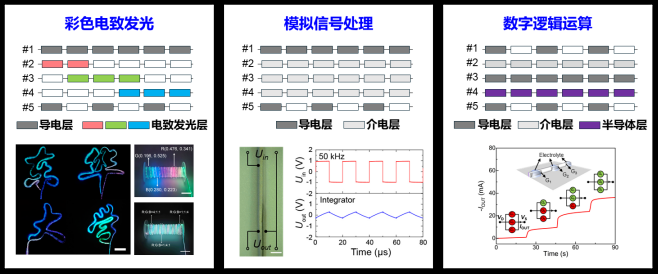
Basic circuit fibers based on three carrier conversion mechanisms (electron–photon, electron–electron, and electron–ion conversion).
In application validation, the researchers placed the spatial-sensing fibers prepared by this method on the inner side of a robotic gripper. The approach or movement of a target causes changes in electric-field coupling, from which the target position can be calculated to drive the robotic arm and achieve automatic target tracking. In another set of experiments, the team used a flexible interactive interface composed of the fibers, together with an accompanying system, to achieve touchless control of a robotic arm and a drone by finger movements.
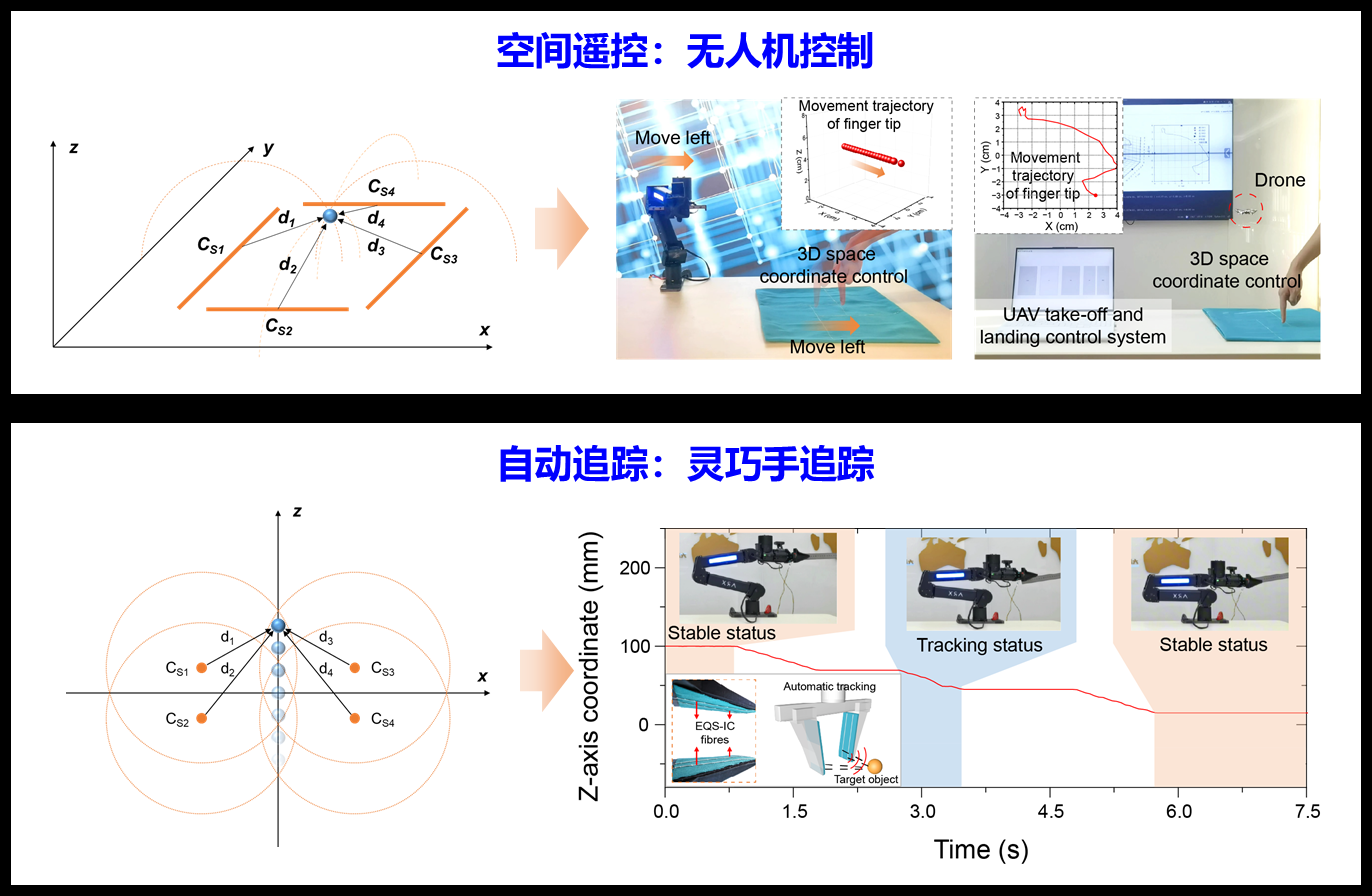
Demonstration of touchless spatial interaction.
From light emission to computation, and further to spatial interaction, the significance of this work lies not merely in separately creating several types of functional fibers, but in establishing a design and manufacturing methodology that connects the spatial organization of functional materials, fiber device construction, and circuit interconnection. While retaining the flexibility, sewability, and weavability of fibers, microfluidic coded spinning provides composable basic modules for different electronic functions. This offers a new technological pathway for wearable computing, flexible human–machine interaction, soft robotics, and embodied intelligence systems.