

Recently, the research group led by Researcher Qianjin Chen at the College of Chemistry and Chemical Engineering has achieved important progress in scanning electrochemical imaging. The work, entitled "Deciphering Site-Specific Kinetics on Shaped Pd Nanocrystals via Single-Particle Electrocatalysis", was published in the Journal of the American Chemical Society (JACS).
The particle size, morphology, and surface structure of nanocrystal catalysts significantly influence their electrocatalytic activity and selectivity. However, even for structurally well-defined nanocrystals, the surface simultaneously contains multiple types of local structural sites, including facets, edges, vertices, and defects. Conventional macroscopic electrochemical measurements yield the averaged response of a large number of catalyst particles, making it difficult to distinguish the intrinsic catalytic contributions of different surface sites. Therefore, establishing a clear structure–activity correlation at the single-nanoparticle scale and deciphering the site-specific kinetics of different sites are key scientific questions in the field.
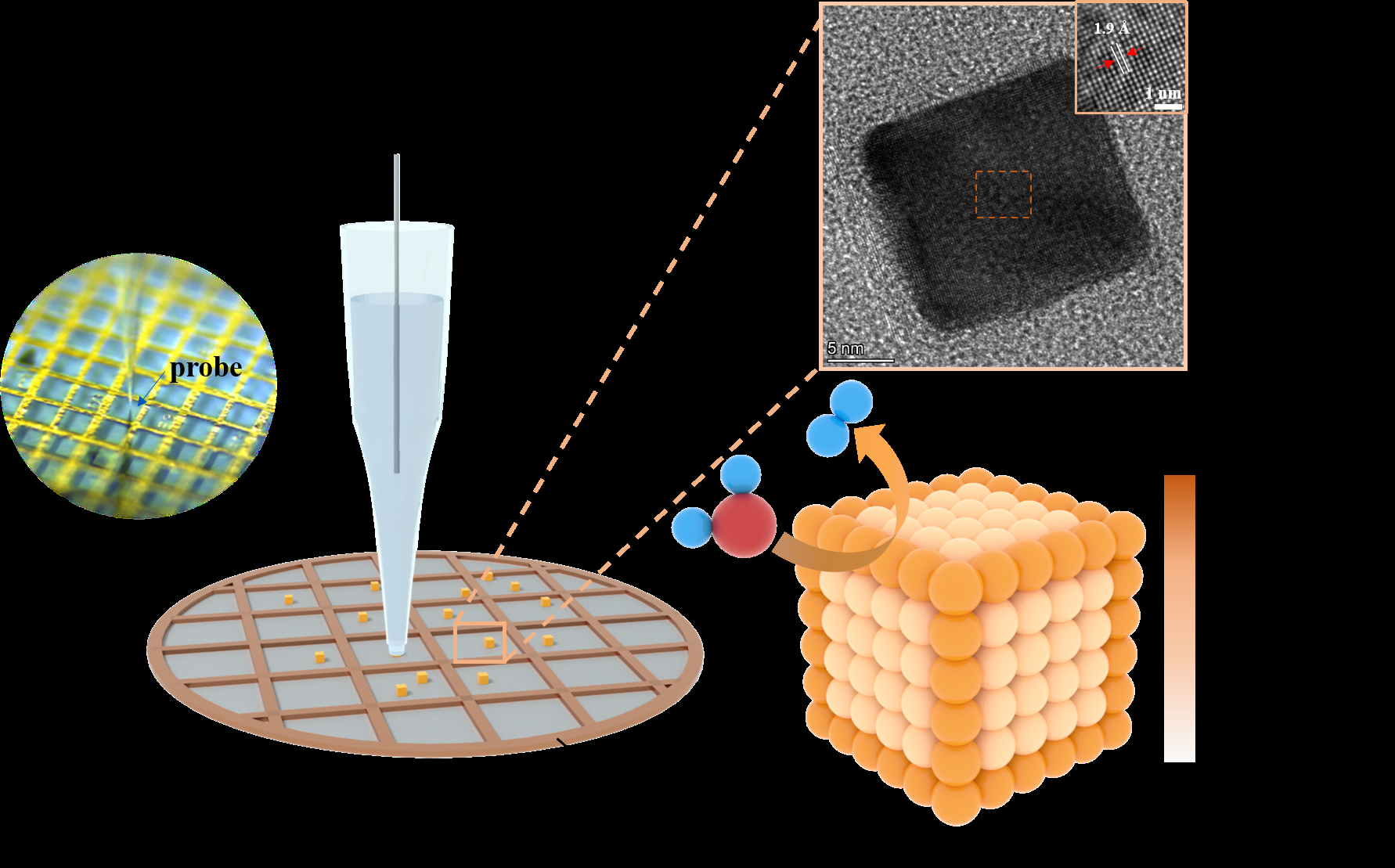
Using morphology-controlled palladium nanocubes as model catalysts, this work developed a SECCM-TEM correlative in situ measurement method combining scanning electrochemical cell microscopy with transmission electron microscopy, achieving precise measurement of the hydrogen evolution reaction (HER) activity of individual Pd nanocrystals and quantitative identification of different surface sites on the same particle. The research team dispersed Pd nanocubes of different sizes onto carbon-film-coated copper grid substrates, obtained the HER electrochemical response of individual particles using microdroplet electrochemical cells, and confirmed the structural information of the corresponding specific particles through co-located transmission electron microscopy. This approach breaks through the spatial resolution limitations of traditional SECCM-SEM correlative measurement methods, achieving single-particle electrocatalytic analysis of Pd nanocrystals as small as 8 nm.
Single-particle electrochemical results show that the HER activity of Pd nanocubes is closely related to particle size. As the particle size decreases, the catalytic activity normalized to unit surface area increases, indicating that the low-coordinated edge sites, which account for a higher proportion in smaller particles, are likely the dominant active centers for the HER. Furthermore, combining geometric models with single-particle statistical results, the research team divided the surface sites of Pd nanocubes into facet sites and edge sites, and quantitatively deciphered their intrinsic catalytic contributions. The results show that the turnover frequency of Pd edge atoms for the HER is approximately 4.3 times that of facet atoms, directly demonstrating the dominant role of low-coordinated edge sites in the HER on Pd nanocrystals.
To further verify this conclusion, the research team designed and synthesized edge-selective Pd–Au nanocubes and fully surface-covered Pd–Au nanocubes. Single-particle measurements show that after the edges are selectively covered with gold, the HER current of the particles decreases significantly; when the particle surface is completely covered with gold, the HER activity almost disappears. Density functional theory calculations indicate that the reaction energy barrier at Pd edge sites is lower than that at facet sites, consistent with the experimentally obtained site-specific activity trend, elucidating the key role of edge sites in the HER on Pd nanocrystals from both experimental and theoretical perspectives.
This work not only quantitatively reveals, at the single-particle scale, the intrinsic electrocatalytic differences between facet and edge sites in Pd nanocubes, but the established SECCM-TEM correlative imaging method can be further extended, providing a feasible methodological platform for deciphering the effects of active sites, structural heterogeneity, and elemental distribution on the catalytic performance of complex nanocatalysts. This research is of great significance for deeply understanding the structure–activity relationships in nano-electrocatalysis and for the rational design of efficient electrocatalysts.
Zengyan Wu, a 2022-level master's student, Weitong Zhang, a 2024-level PhD candidate at the College of Chemistry and Chemical Engineering, and Wenxuan Fan, a master's student at Anhui University of Technology, are the co-first authors of the paper. Researcher Qianjin Chen of Donghua University and Professor Mingkai Liu of Anhui University of Technology are the co-corresponding authors. Donghua University is the first corresponding affiliation. This research was supported by the collaborative support of Professor Jie Zeng of Anhui University of Technology/University of Science and Technology of China.
Paper link: https://doi.org/10.1021/jacs.6c03289