

Recently, the research group led by Professor Tao Zhao at the College of Chemistry and Chemical Engineering has achieved important progress in integrated firefighting early-warning and sensing wearable equipment. The work, entitled "Extra-Protective-Layer-Free Integrated Textile for Robust Protection and Highly Sensitive Bimodal Sensing in Firefighting", has been published in Advanced Functional Materials.
In the design of modern firefighting suits, integrating physical protection with physiological/environmental sensing functions is a core future development trend. However, due to the extremely harsh fire-scene environment, traditional fabrication strategies typically stack additional water-proof and flame-retardant functional protective layers outside the conductive sensing layer. This traditional "stacking" multilayer structure severely hinders the transmission of external physical stimuli such as force and heat to the inner sensing layer, substantially reducing the sensitivity and response speed of the sensors. Therefore, how to break the inherent contradiction between external passive physical protection and internal active sensing sensitivity is a key scientific problem for the practical application of integrated firefighting equipment.
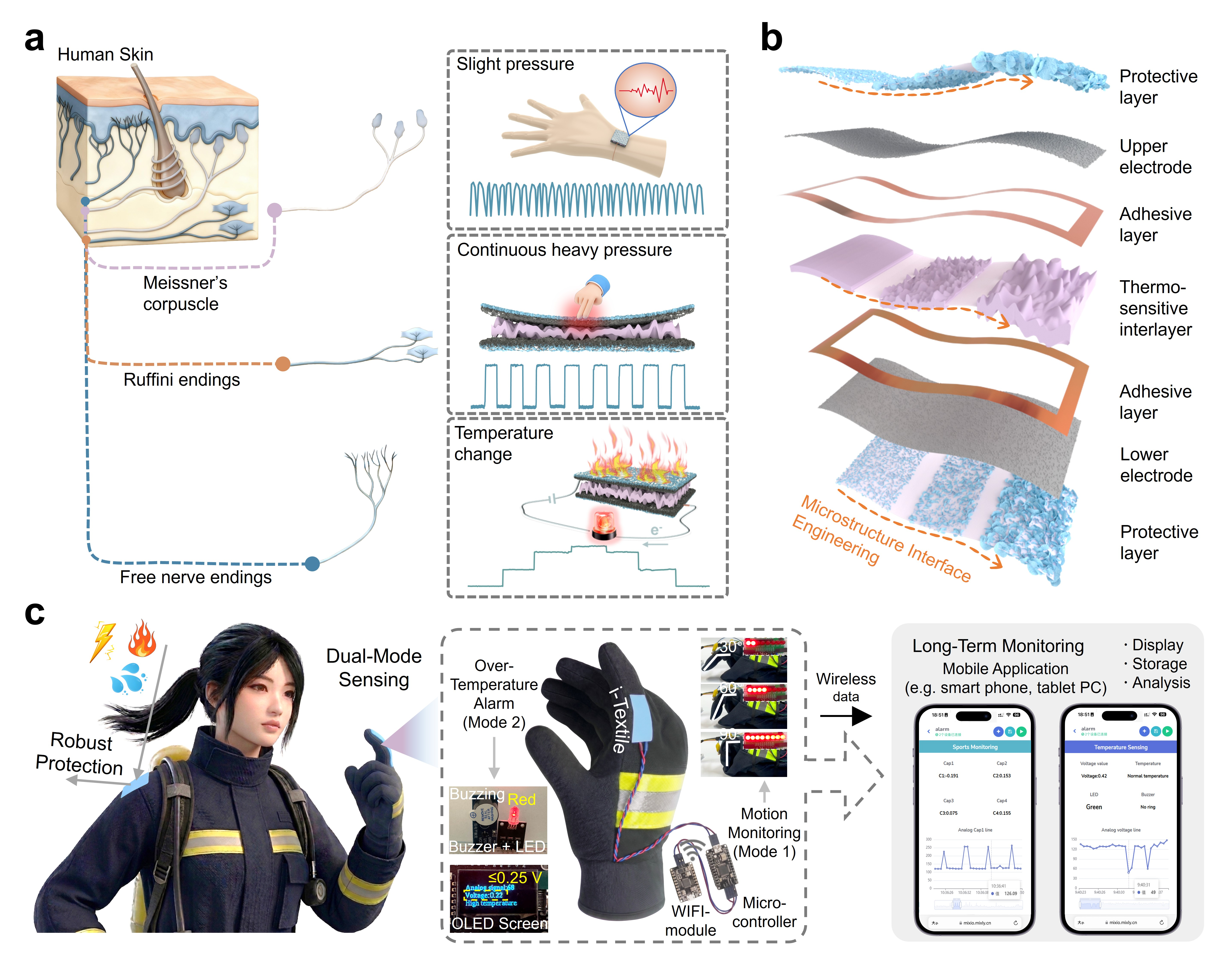
This work proposes a new design strategy for integrated textiles (i-Textile) without an additional protective layer. Inspired by the structure of human skin, the research team endowed conventional cotton fabric with an asymmetric functional structure through spatially selective deposition technology. The researchers first uniformly deposited a complex of 1,4,7,10-tetraazacyclododecane (Cyclen) and copper sulfate on the cotton fabric, then grew vertically aligned micrometer-scale copper hydroxide flakes in situ, firmly wrapped by a crosslinked polymer network; finally, nanoscale polypyrrole (PPy) particles were deposited on one side of the fabric via single-sided interfacial polymerization. This exquisite micro-nano hierarchical design endows the modified asymmetric fabric (ACF) with excellent electrical conductivity on one side (inner electrode) and outstanding superhydrophobicity, flame retardancy, and electrical insulation on the other side (outer protection).
As an integrated device for fire rescue, its external protective capability is the cornerstone for ensuring stable operation of the sensor in fire scenes. Tests show that the superhydrophobic surface on the outer side of the modified fabric exhibits contact angles exceeding 160° for both deionized water and artificial sweat, offering excellent water repellency and self-cleaning functions. In addition, the introduced phosphorus-containing polymer and metal components endow the fabric with a limiting oxygen index as high as 30.7%, enabling it to withstand repeated and prolonged flame exposure without being ignited. Through density functional theory (DFT) calculations and IGMH analysis, the team revealed that the hydrogen-bonding network contributes up to 63.61% of the binding energy in the interaction between the fiber matrix and the functional coating. This strong interfacial interaction ensures that the fabric maintains stable superhydrophobicity and flame retardancy even after 50 standard soaping cycles.
On the basis of achieving strong physical protection, the research team placed a porous thermosensitive chitosan interlayer between two layers of asymmetric fabric, constructing a complete bimodal integrated textile. In the capacitive mode (mechanical monitoring), the device exhibits extremely high sensitivity to tiny stresses (GF = 41.59 N⁻¹) and ultrafast response (0.25 s), accurately capturing firefighters' physiological motion signals such as breathing and running; in the resistive mode (overtemperature early warning), benefiting from the absence of an additional physical thermal insulation layer, its response time to high-temperature flames is only 1.89 s, far superior to traditional smoke alarms. To resolve the severe electrical crosstalk caused by directly connecting the two detection circuits in parallel, the team innovatively introduced an asymmetric time-division multiplexing (TDM) circuit strategy, successfully achieving non-interfering and stable parallel operation of highly sensitive physiological motion monitoring and rapid overtemperature early warning on a cloud platform.
This work not only achieves a perfect integration of extremely robust multifunctional protection (superhydrophobicity and durable flame retardancy) with highly sensitive bimodal sensing on a single piece of fabric, successfully eliminating the bulky "additional protective layers" of traditional integrated garments, but the established time-division multiplexing circuit decoupling strategy also provides a feasible methodological platform for resolving multimodal sensing signal interference. This research is of great significance for deeply understanding the stimulus-transmission mechanisms inside wearable devices and for the rational design of next-generation high-performance, multifunctional integrated wearable equipment for firefighting.
Zexin Chen, a master's student at the College of Chemistry and Chemical Engineering, is the first author of the paper, and Professor Tao Zhao is the corresponding author. Donghua University is the sole corresponding affiliation.
Paper link: https://doi.org/10.1002/adfm.76070