

Recently, the research team led by Professor Jinli Qiao at the College of Environmental Science and Engineering of Donghua University has achieved important progress in alkaline water electrolysis for hydrogen production. The related work, entitled "Synergistic optimization of pore structure and hydrophilicity for an ultrathin, high-safety composite diaphragm toward high-current, durable alkaline water electrolysis", was published in Science Bulletin.
To resolve the contradiction among the thickness, ionic conductivity, and gas barrier properties of composite diaphragms—the core component of alkaline water electrolysis (AWE)—the team proposed a simple, economical, and easily scalable strategy that simultaneously regulates the pore structure of the composite diaphragm and endows it with hydrophilicity, successfully fabricating an ultrathin composite diaphragm with a thickness of only 220 µm, whose performance far surpasses that of the third-generation commercial composite diaphragms represented by Agfa of Belgium. By introducing sodium carboxymethyl cellulose (CMC), the team constructed a three-dimensional supramolecular hydrogen-bonding network of CMC, PVP, and ZrO₂ within the diaphragm, achieving excellent stability of the ultrathin composite diaphragm under harsh operating conditions. More critically, a continuous nanopore structure with low tortuosity was formed. This unique nanoporous structure not only provides high-speed transport channels for OH⁻ but also maintains excellent gas barrier performance. Moreover, the hydroxyl and carboxyl functional groups abundant in CMC effectively reduce the wetting resistance of the electrolyte to the diaphragm, further accelerating OH⁻ conduction.
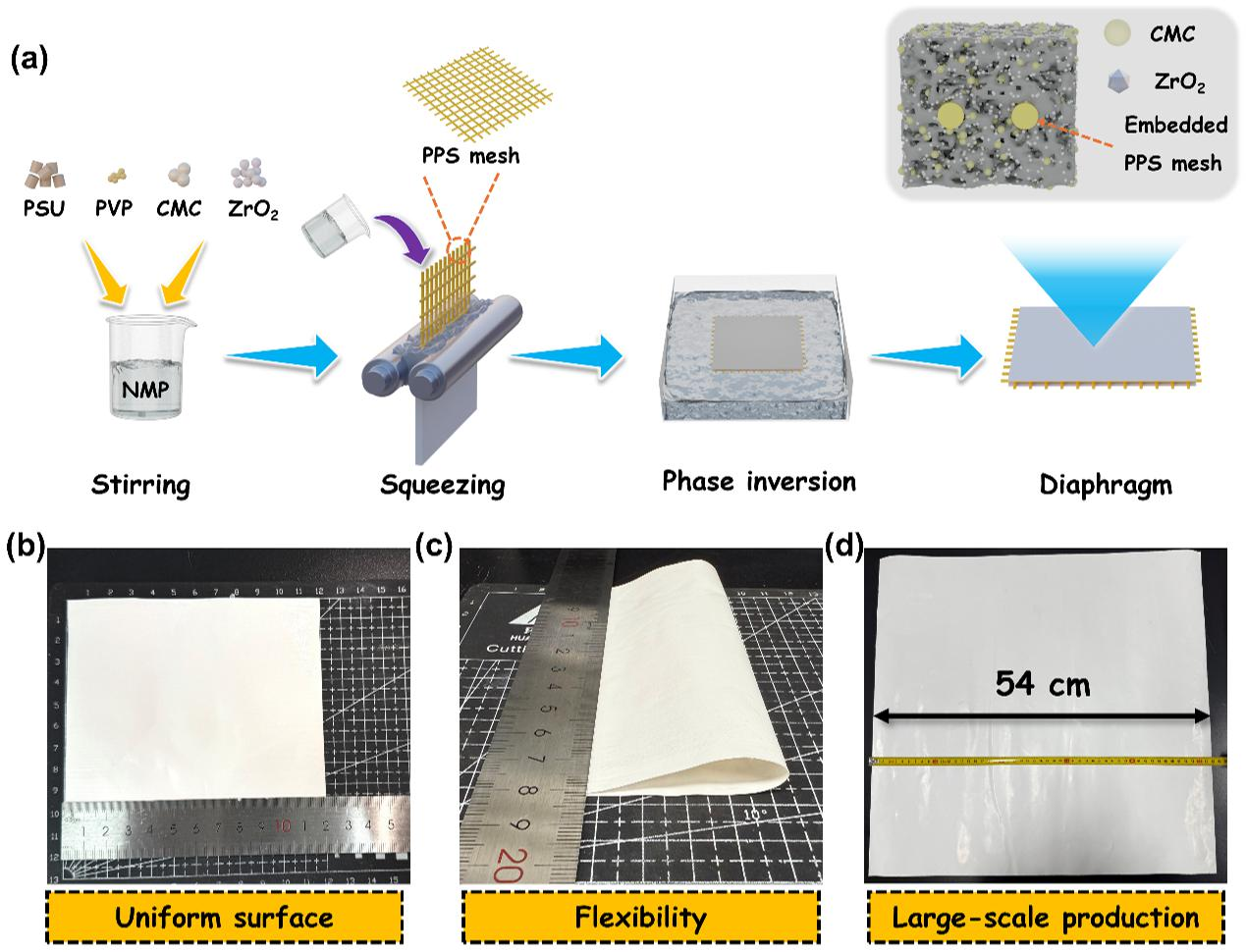
Figure 1. (a) Schematic illustration of the preparation process of CMC–ZrO₂/PSU series diaphragms. Photographs of the CMC2Z83 diaphragm: (b) surface, (c) rolled state, (d) large-area diaphragm (52 × 54 cm²).
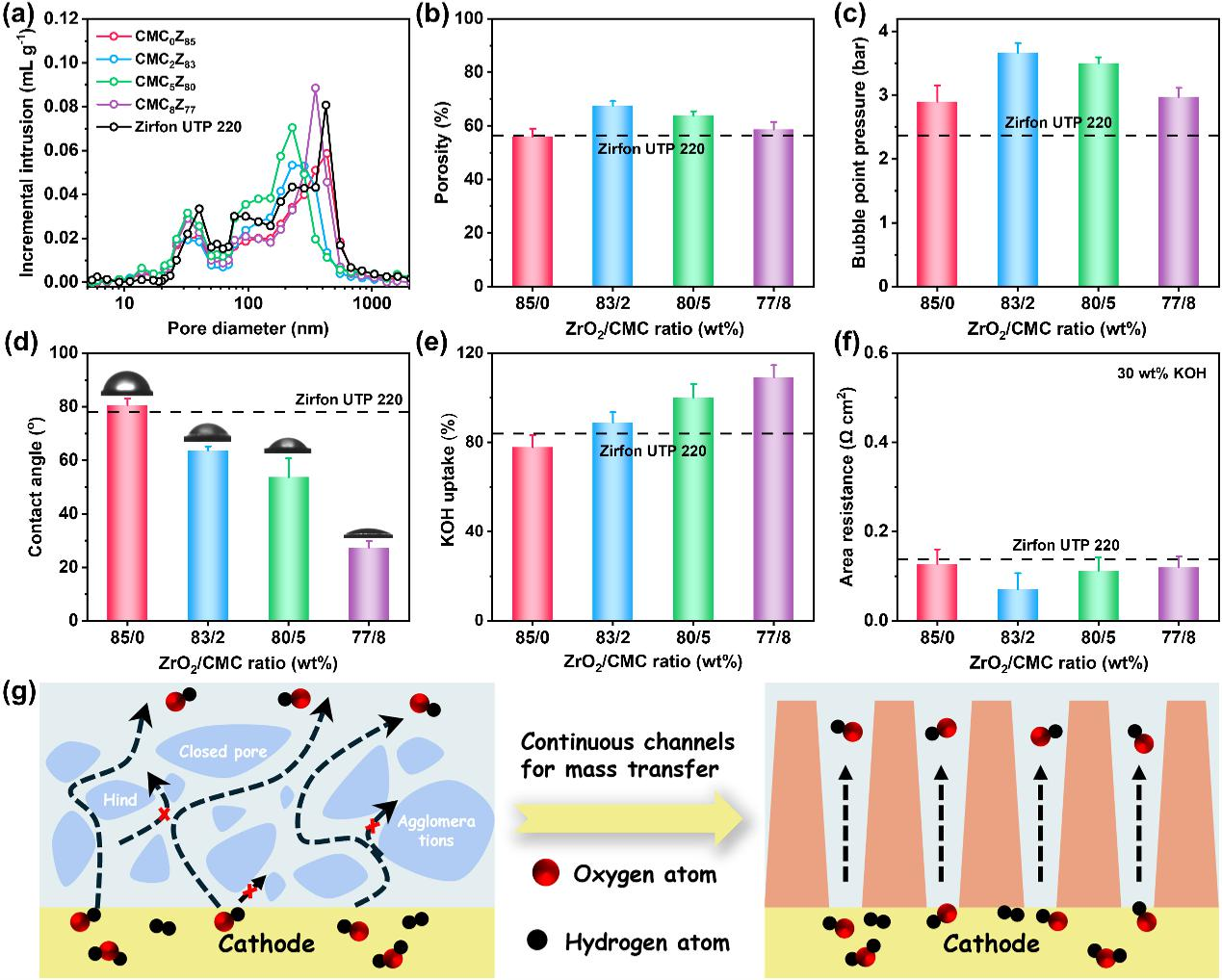
Figure 2. Characterization of the basic properties of CMC–ZrO₂/PSU series diaphragms. (a) Incremental intrusion curves of Zirfon UTP 220 and CMC–ZrO₂/PSU series diaphragms measured by mercury porosimetry as a function of pore diameter; (b) porosity, (c) bubble point pressure, (d) contact angle, (e) electrolyte uptake in 30 wt% KOH, and (f) area resistance of CMC–ZrO₂/PSU series diaphragms; (g) OH⁻ transport mechanism of CMC–ZrO₂/PSU series diaphragms.
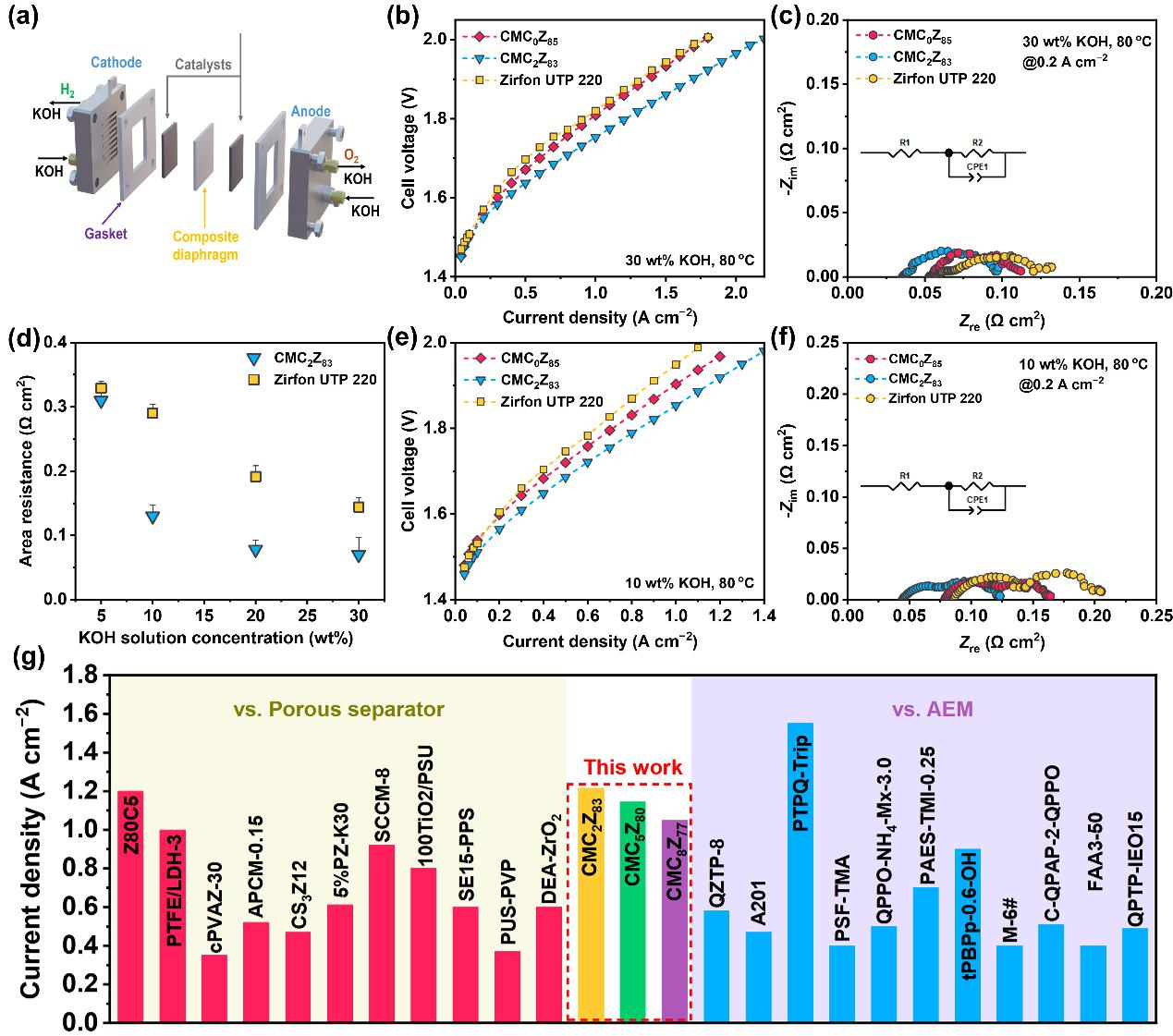
Figure 3. AWE performance of CMC–ZrO₂/PSU series diaphragms. (a) Schematic illustration of the self-built alkaline water electrolyzer. Polarization curves of Zirfon UTP 220, CMC0Z85, and CMC2Z83 diaphragms measured in (b) 30 wt% KOH and (e) 10 wt% KOH; EIS plots of Zirfon UTP 220, CMC0Z85, and CMC2Z83 diaphragms measured in (c) 30 wt% KOH and (f) 10 wt% KOH; (d) area resistance of Zirfon UTP 220 and CMC2Z83 diaphragms as a function of KOH concentration; (g) comparison of the current densities of CMC2Z83, CMC5Z80, and CMC8Z77 diaphragms with previously reported AWE diaphragms at a cell voltage of 1.8 V.
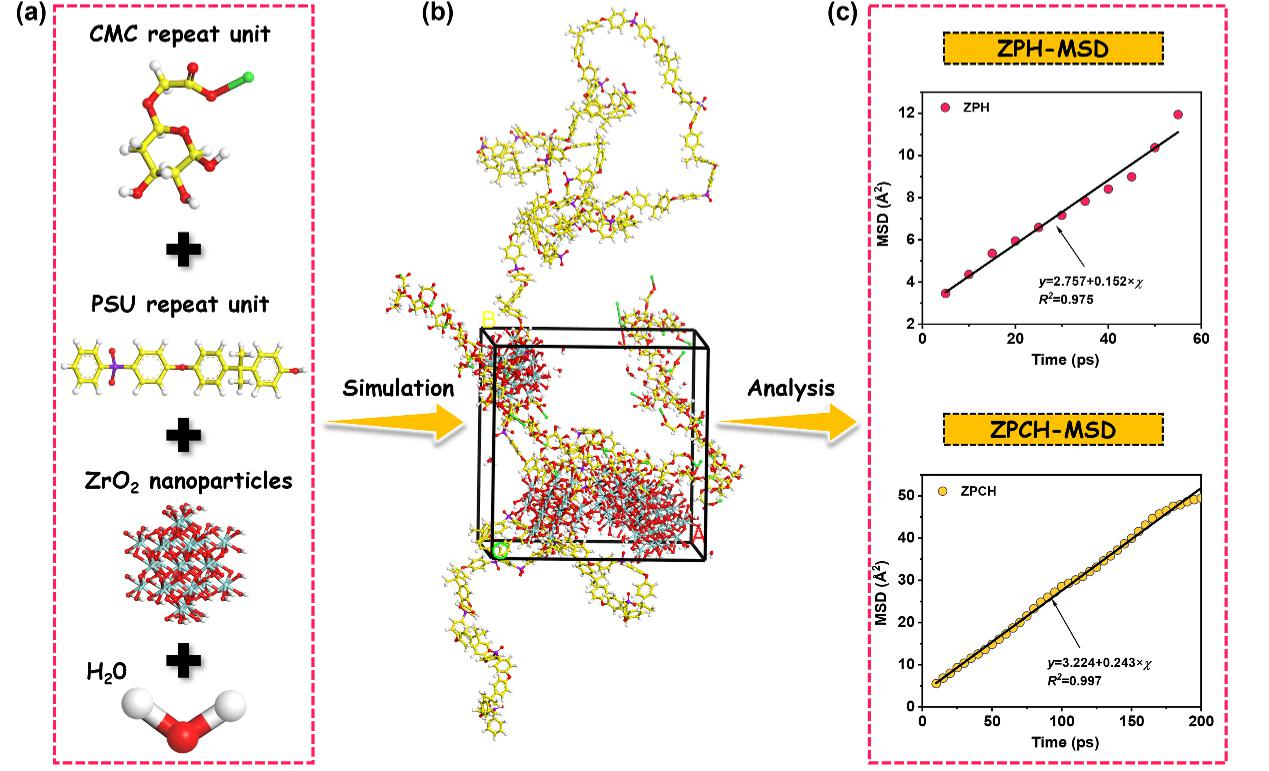
Figure 4. Molecular dynamics simulations of water transport in CMC–ZrO₂/PSU diaphragms. (a) Schematic structural model of the diaphragm assembly; (b) structural model of ZPCH; (c) water diffusion curves of the ZPH and ZPCH models.
In this study, a single-cell electrolyzer system equipped with the CMC2Z83 diaphragm achieved an ultrahigh current density of 2.2 A cm⁻² at 2.0 V, along with high-purity gas production (AHCs of only 0.09% at a current density of 0.2 A cm⁻²). Meanwhile, a short stack equipped with the CMC2Z83 diaphragm operated continuously for 30 days (~720 h) under dynamic conditions (start–stop, high/low temperature, and large/small current density switching) without decay or powder shedding, maintaining highly stable structural and electrochemical performance.
In addition, in recent years, the team led by Professor Jinli Qiao has achieved a series of results in developing high-performance composite anion-exchange membranes for water electrolysis hydrogen production and rechargeable zinc–air batteries, which have been successively published in Adv. Funct. Mater., 2026; Energy Mater. Adv., 2026; J. Membr. Sci., 2025, 735, 124583; Chem. Eng. J., 2025, 510, 161697; Adv. Funct. Mater., 2024, 2410009; and eScience, 2024, 4, 100290.
Paper link: https://doi.org/10.1016/j.scib.2026.05.070