

Recently, the research group led by Professor Tao Yi at the College of Chemistry and Chemical Engineering has made new progress in the precise portable diagnosis of early kidney injury. The related research, entitled "Unimolecular dual-reporter probes for early kidney injury diagnosis through synchronous in situ imaging and portable urinalysis", was published in National Science Review (NSR). This study innovatively proposed a "dual-pronged" diagnostic strategy combining in situ in vivo tracing with portable in vitro urinalysis, and successfully developed a unimolecular dual-reporter probe, which is expected to enable accurate point-of-care rapid detection before irreversible damage to renal function occurs.
Acute kidney injury (AKI) is a common critical clinical syndrome, affecting approximately 15% of hospitalized patients and more than 50% of intensive care unit patients, with a high mortality rate. However, traditional clinical diagnostic indicators such as blood urea nitrogen and serum creatinine often only change significantly after more than half of renal function has been lost, at which point the kidneys have already suffered irreversible damage and the optimal window for intervention is easily missed. Therefore, developing methods capable of early and precise diagnosis of kidney injury is of great significance for timely clinical intervention and treatment and for reducing patient mortality risk.
Traditional kidney injury diagnostic probes mostly adopt a single-reporting mode, being used either only for in vivo imaging or only for in vitro urinalysis, and suffer from poor diagnostic accuracy and limited specificity. In previous studies, the group led by Professor Tao Yi used methylene blue (MB) as a structural core to design and develop a series of reactive oxygen species (ROS)-responsive controlled-release platforms based on the 2-aminobenzyl alcohol self-immolative structure, and constructed various molecular tools for the diagnosis and treatment of related diseases (Angew. Chem. Int. Ed., 2022, 61, e20211680; Chem. Sci., 2022, 13, 10815; J. Control. Release, 2024, 376, 961; Adv. Mater., 2024, 36, 2309789; J. Am. Chem. Soc., 2025, 147, 25325-25336; Angew. Chem. Int. Ed., 2025, 64, e202510441). On this basis, through modular molecular structure design, this work innovatively integrated three functional units—a photoacoustic signal tracing module (croconic acid, CA), an ROS-activated near-infrared fluorescence module (methylene blue, MB), and a hydrophilicity-regulating kidney-targeting module (PEG)—to construct the unimolecular dual-reporter probe DHU-AKI-3, featuring activatable crosstalk-free multiplexed signal output. The probe can be specifically activated by ROS highly expressed in injured kidney regions, simultaneously generating two mutually non-interfering detection signals: the released CA, owing to its hydrophobicity, precipitates in situ in the injured kidney, forming a photoacoustic signal lasting up to 60 hours for long-term in situ monitoring of kidney injury; meanwhile, the released hydrophilic MB is rapidly excreted in urine, enabling in vitro diagnosis through fluorescence or color changes. This "dual-pronged" design strategy of the unimolecular probe synchronously realizes mutual validation of in vivo photoacoustic signals and in vitro urinalysis signals, improving the accuracy of diagnostic results.
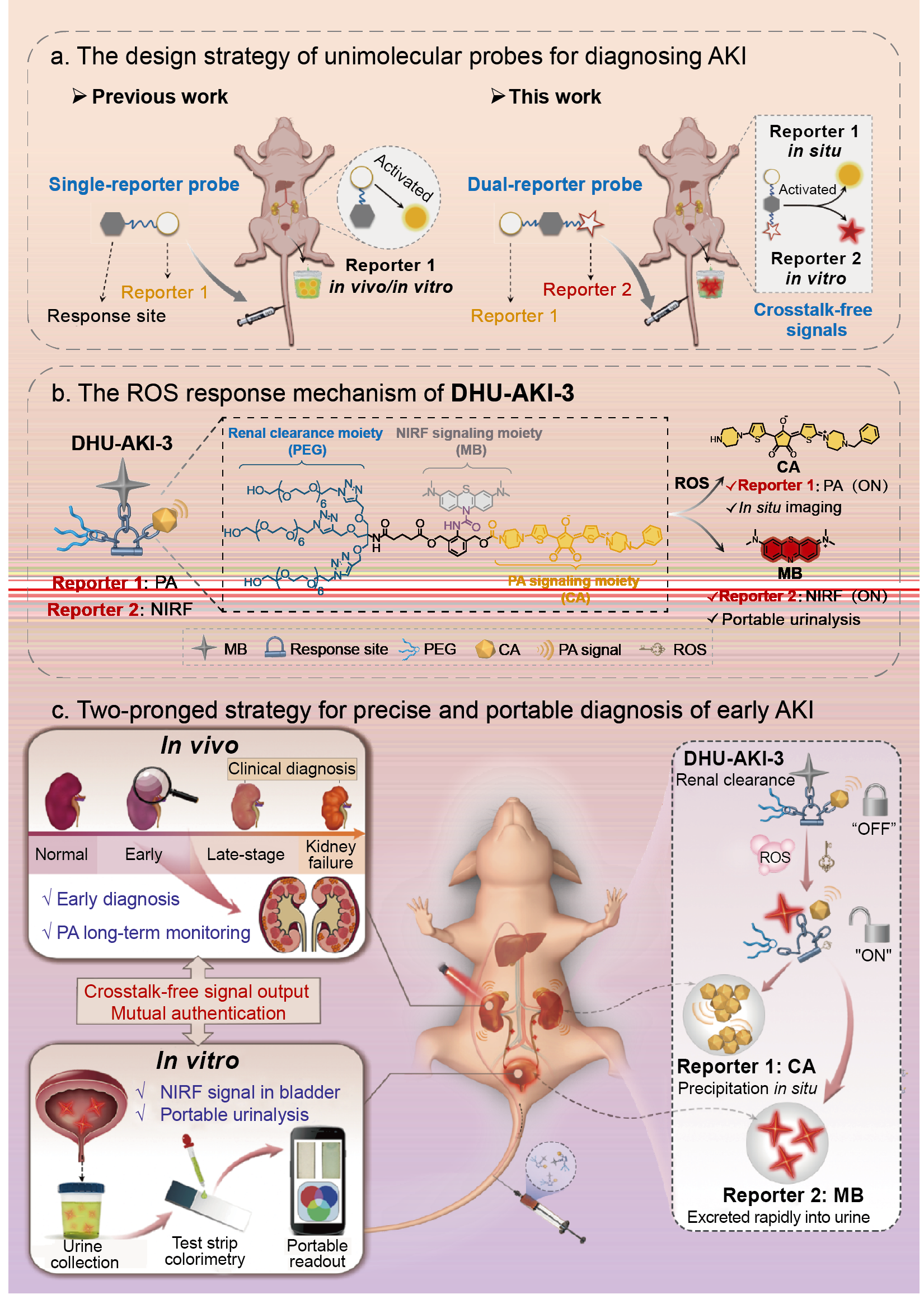
In multiple mouse models (drug-induced kidney injury and unilateral renal ischemia-reperfusion injury), the probe accurately detected the onset of early kidney injury before traditional clinical diagnostic indicators showed obvious changes. The research team further developed a smartphone-assisted colorimetric urinalysis method: the urine sample is simply dropped onto a test strip, and an image is captured with a smartphone camera, and the diagnostic result can be rapidly read using color recognition software. This work not only provides a new molecular tool for early precise and portable diagnosis of acute kidney injury, but also offers a technical reference for the development of diagnostic technologies in clinical scenarios such as intensive care and post-kidney-transplantation monitoring.
Specially Appointed Associate Researcher Lingyan Liu of the College of Chemistry and Chemical Engineering of Donghua University and Assistant Professor Feiyang Liu of the School of Medicine of Guangxi University are the co-first authors of the paper. Dr. Qihang Ding of Korea University, Associate Professor Peng Wei of Donghua University, Academician Jong Seung Kim of Korea University, and Professor Tao Yi of Donghua University are the co-corresponding authors, with Donghua University as the first corresponding affiliation.
Paper link: https://doi.org/10.1093/nsr/nwag367