

Recently, the research team led by Professor Jinli Qiao from the College of Environmental Science and Engineering of Donghua University has made new progress in anion-exchange composite membranes for alkaline water electrolysis hydrogen production. The related research, entitled "Dipole Moment Induced Micro-Nanopore Modulation Enables Dual-Functional Conductive Anion Exchange Composite Membranes", was published in Advanced Functional Materials. By employing dual porogens (polyvinylpyrrolidone/polyethylene glycol) to induce dipole moment synergy and component modulation, complemented by the coupling of cationic sites (guar hydroxypropyltrimonium chloride), the research team successfully constructed a series of novel porous anion-exchange composite membranes (PAECM) with surface micro-nanopores, thereby achieving dual-function transfer through channel transferring and site hopping.
The developed PAECM-ZPGG1 (~350 µm) membrane exhibits a high bubble point pressure (~3.9 bar) and a low area resistance (~0.14 Ω cm⁻²). Using a commercial nickel–aluminum catalytic electrode, a high current density of 1.89 A cm⁻² at 2 V was achieved (80 °C, 30 wt.% KOH), along with stable operation for up to 480 h at 1 A cm⁻². This strategy of pore-structure modulation and ion-transfer site anchoring provides prospective insights for the simultaneous optimization of gas barrier properties and high ion-transfer capability in porous composite membranes. This work was supported by the National Natural Science Foundation of China (Grant No. 22572026) and other projects.
PhD student Yongnan Zhou is the first author of the paper, Professor Jinli Qiao is the corresponding author, and Donghua University is the first corresponding affiliation.
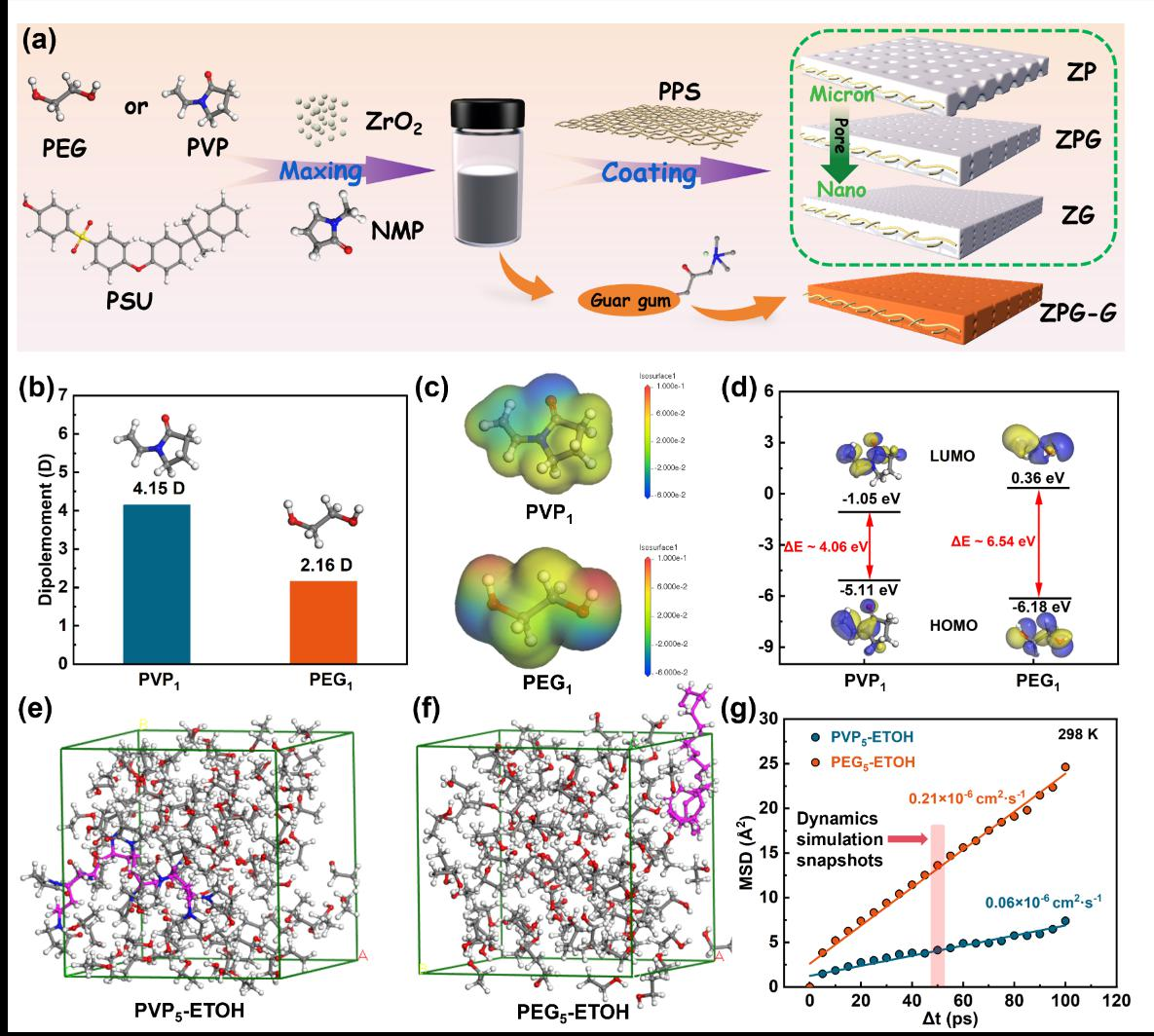
Figure 1. (a) Schematic illustration of the preparation of PAECM. (b) Molecular electric dipole moments of PVP1 and PEG1 molecules, and (c) their charge distributions. (d) LUMO and HOMO energy levels of the PVP1 and PEG1 model compounds. (e, f) Snapshots of molecular dynamics simulations at 50 ps (PVP5 and PEG5 molecules dissolved in 100 ethanol molecules), and (g) the corresponding mean square displacement curves.
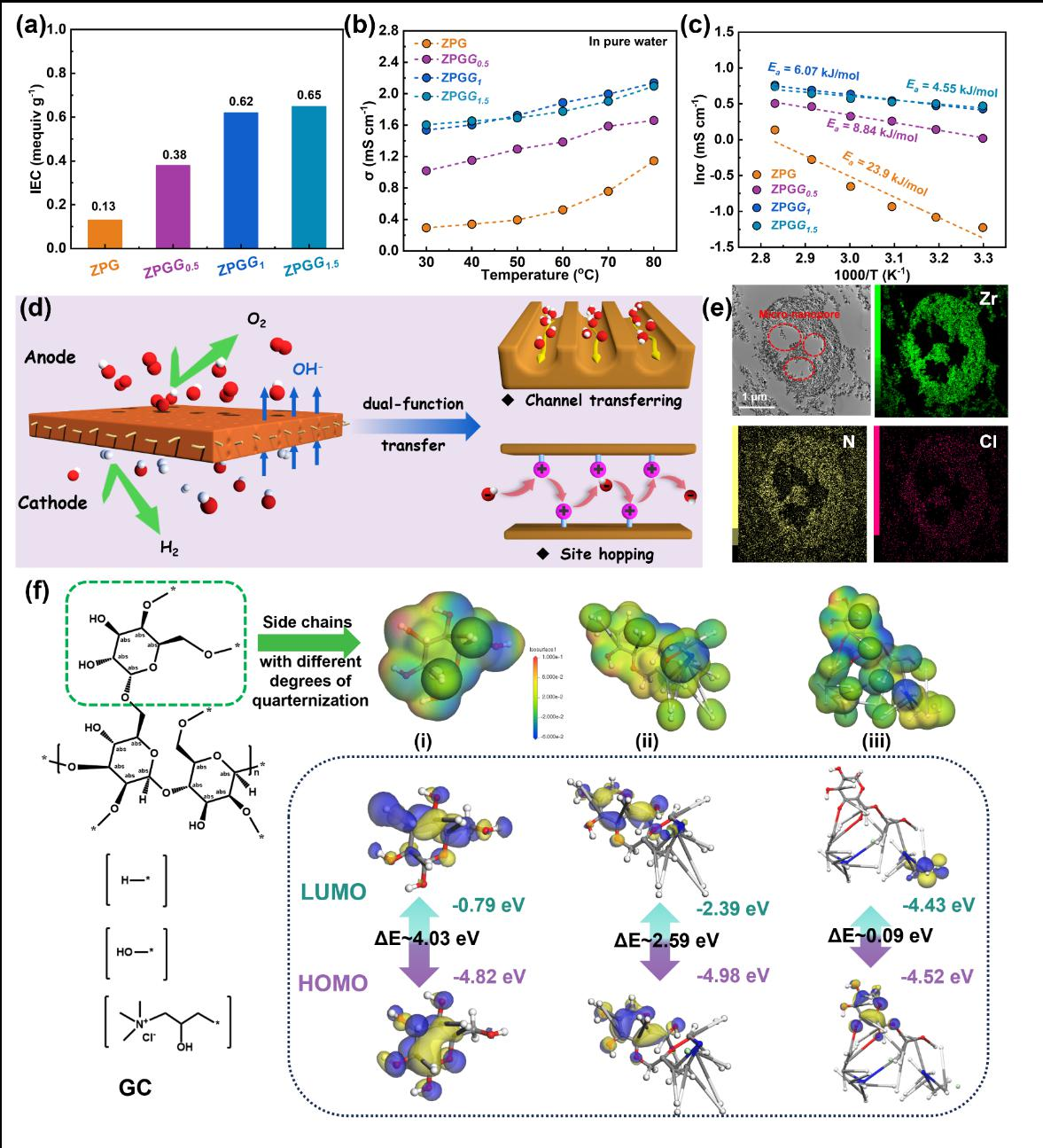
Figure 2. (a) IEC, (b) conductivities of ZPG and ZPGGX (X = 0.5, 1, 1.5 wt.%) composite membranes at different temperatures, and (c) Arrhenius plots. (d) Dual-function transfer pathways of the composite membranes. (e) Transmission electron microscopy (TEM) image and energy dispersive spectroscopy (EDS) elemental analysis of a membrane surface section; (f) charge density distributions and charge levels of side-chain models with different quaternization degrees in the GC molecule.
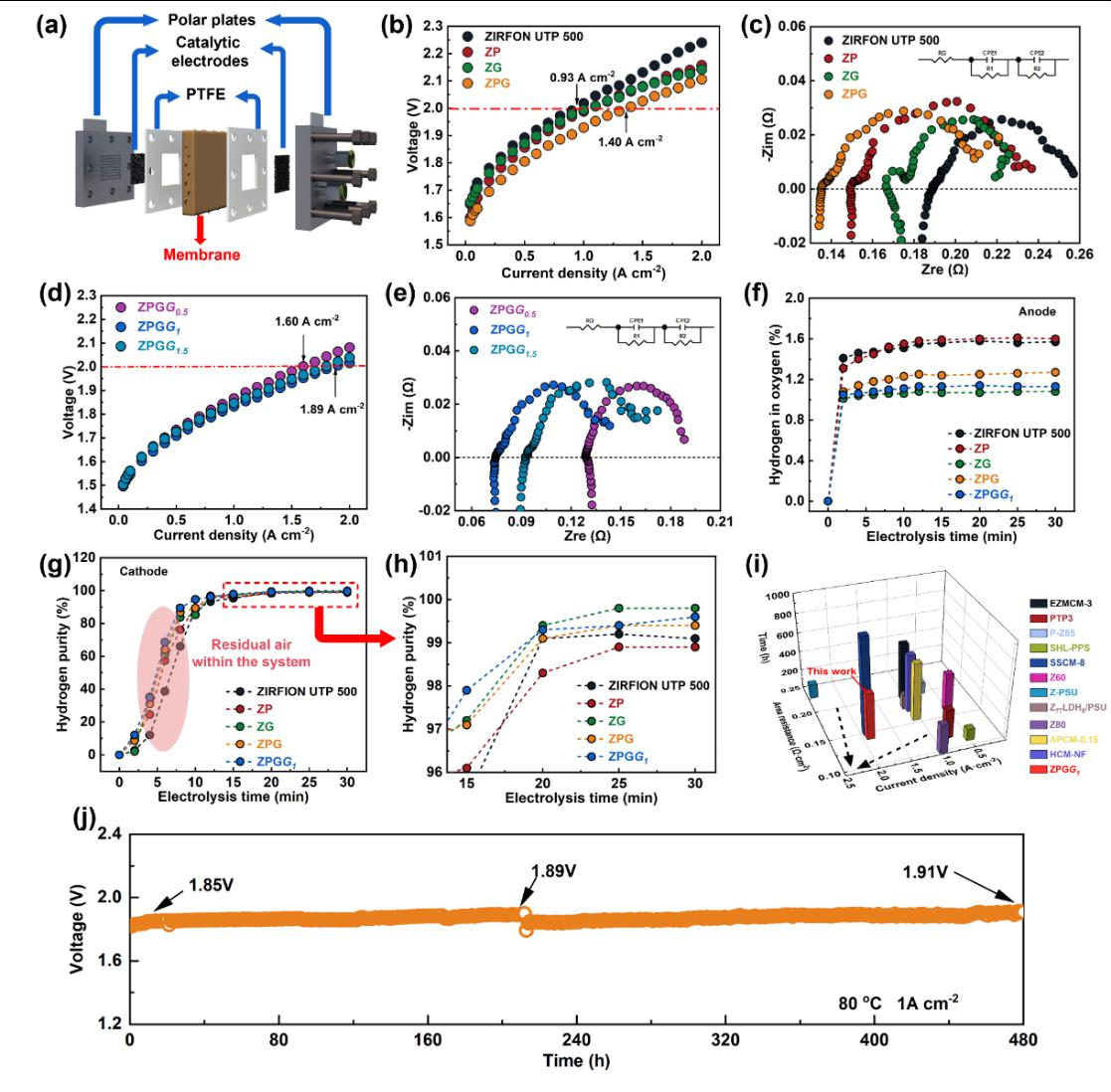
Figure 3. Performance of the composite membranes in alkaline water electrolysis. (a) Schematic illustration of the electrolysis system components. (b, c) Polarization curves and Nyquist impedance plots of the ZIRFON UTP 500, ZP, ZG, and ZP composite membranes, and (d, e) of the ZPGGX (X = 0.5, 1, 1.5 wt.%) composite membranes (current density of 200 mA cm⁻²). (f) Hydrogen content in the oxygen produced at the anode side of the composite membranes. (g, h) Purity of the hydrogen produced at the cathode side. (i) Comparison of alkaline water electrolysis performance with previously reported results. (j) Durability test of the ZPGGX (X = 0.5, 1, 1.5 wt.%) composite membranes at a current density of 1 A cm⁻² for 480 h.
Paper link: https://doi.org/10.1002/adfm.76467