

Recently, the research team led by Professor Jinli Qiao from the College of Environmental Science and Engineering of Donghua University has achieved important progress in constructing high-performance rechargeable zinc–air batteries via electrospinning technology. The related work, entitled “Dual-Role Zn Engineering Enables Electron Redistribution and Hierarchical Porosity in Co–N4 Carbon Nanofibers for Efficient Zinc–Air Batteries”, has been published in Advanced Functional Materials, a prestigious international journal in the field of materials science.
Developing bifunctional oxygen electrocatalysts with both high intrinsic activity and efficient mass transport remains a key challenge for rechargeable zinc–air batteries (ZABs). The research team proposed a dual-role Zn engineering strategy based on electrospinning technology to simultaneously regulate the electronic structure and construct hierarchical porosity in Co–N4 carbon nanofibers (Zn/Co–N@CNF). During the electrospinning–pyrolysis process, Zn acts as an electronic regulator that modulates the electronic environment of neighboring Co–N4 sites, inducing electron redistribution and a downward shift of the Co d-band center to −3.43 eV, thereby optimizing the adsorption energetics of oxygen intermediates. Meanwhile, Zn evaporation serves as a dynamic porogen that promotes the generation of highly dispersed Co sites and induces the formation of hierarchical pores, facilitating mass transport and maximizing active-site accessibility. First-principles calculations reveal that the Zn–N4/Co–N4 sites enable optimized adsorption of oxygen intermediates, leading to ultralow theoretical overpotentials of 0.37 V for the oxygen reduction reaction (ORR) and 0.43 V for the oxygen evolution reaction (OER). Benefiting from this structural–electronic synergy, Zn/Co–N@CNF exhibits excellent bifunctional oxygen electrocatalytic performance with a ΔE of only 755 mV. When employed as an air cathode, the assembled zinc–air battery delivers a peak power density of up to 303 mW cm⁻² and remarkable cycling stability exceeding 1150 h without an additional carbon diffusion layer. This work establishes a dual-role metal engineering strategy that integrates electronic modulation with hierarchical porosity, offering new insights for constructing high-performance air electrodes and advancing next-generation zinc–air batteries.
PhD student Tuo Lu is the first author of the paper, Professor Jinli Qiao is the corresponding author, and Donghua University is the first corresponding affiliation.
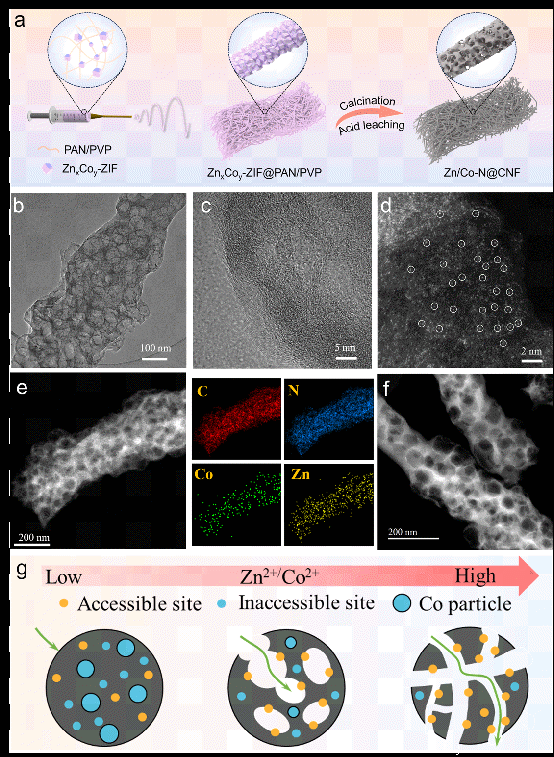
Figure 1. (a) Schematic illustration of the synthesis of Zn/Co–N@CNF, (b–c) transmission electron microscopy (TEM) images, (d, f) high-angle annular dark-field scanning transmission electron microscopy (HAADF-STEM) images, (e) elemental mapping of Zn/Co–N@CNF, (g) formation mechanism of metal single atoms and pores.
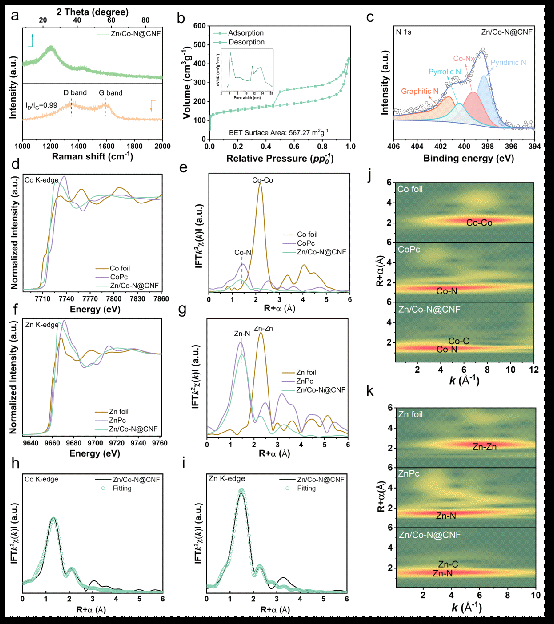
Figure 2. (a) XRD and Raman spectra, (b) N₂ adsorption–desorption isotherms (inset: pore size distribution), (c) high-resolution N 1s spectra, (d, e) normalized XANES spectra at the Co and Zn K-edges, (f, g) corresponding FT-EXAFS spectra, (h, i) EXAFS fitting curves at the Co and Zn K-edges (inset: Co–N4 and Zn–N4 models), (j–k) WT-EXAFS contour plots of Zn/Co–N@CNF.
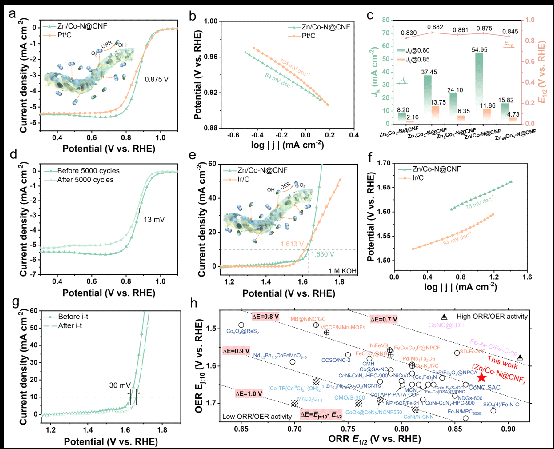
Figure 3. (a) ORR LSV curves of different catalysts, (b) corresponding ORR Tafel slopes, (c) E₁/₂ values and Jk of different catalysts at 0.80 V and 0.85 V, (d) ORR LSV curves before and after 5000 cycles, (e) OER LSV curves, (f) corresponding OER Tafel slopes, (g) OER LSV curves before and after i–t tests, (h) comparison of the ORR/OER activity of Zn/Co–N@CNF with recently reported catalysts.
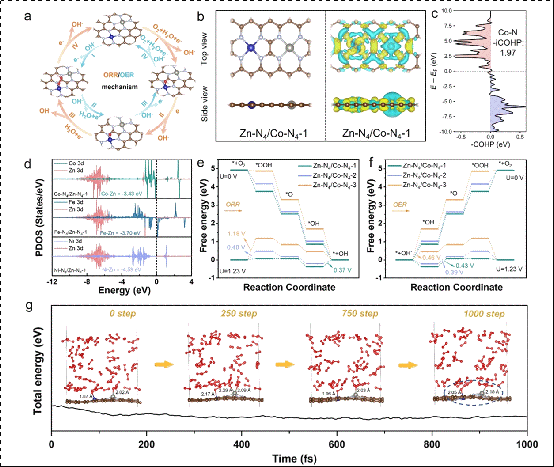
Figure 4. DFT analysis: (a) reaction mechanism pathways (clockwise: ORR process; counterclockwise: OER process), (b) top view/side view and charge density difference of the Zn–N4/Co–N4-1 structure, (c) crystal orbital Hamilton population (COHP) of the Co–N bond, (d) projected density of states (PDOS) of different metal d orbitals, (e–f) ORR/OER free energy diagrams at applied potentials of U = 0 and 1.23 V, (g) AIMD simulation of 1000 steps at 300 K.
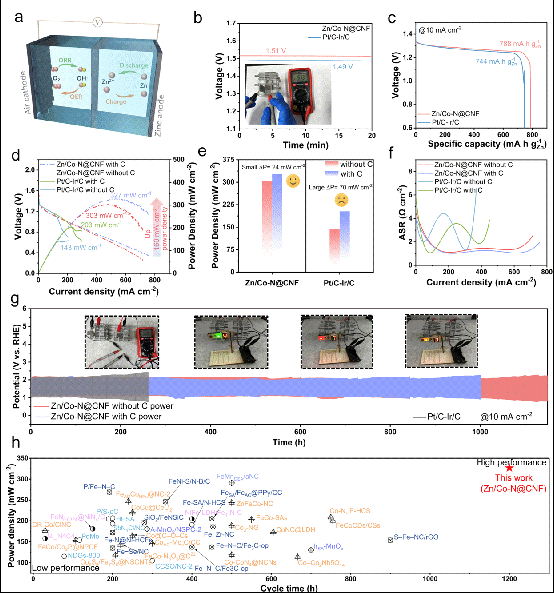
Figure 5. (a) Schematic illustration of ZABs, (b) open-circuit voltage (OCV) curves, (c) specific capacity at 10 mA cm⁻², (d) discharge polarization and power density curves, (e) peak power density differences of Zn/Co–N@CNF and Pt/C–Ir/C with and without carbon layers, (f) corresponding ASR curves, (g) discharge–charge cycling curves at 10 mA cm⁻² (inset: two ZABs lighting indicator lamps), (h) comparison of the cycling lifetime, peak power density, and specific capacity of the ZABs with recently reported literature.
Paper link: https://doi.org/10.1002/adfm.77161