

Recently, the research group of Professor Qianjin Chen, part of the Intelligent Health Management Team led by Professor Tao Yi from the College of Chemistry and Chemical Engineering, has made an important breakthrough in the field of single particle electrocatalysis. This work was published in the internationally renowned journal ACS Nano under the title “Spin Polarization Tailored Oxygen Evolution of Chiral Gold Nanocrystals Probed by Single Particle Electrochemistry”.
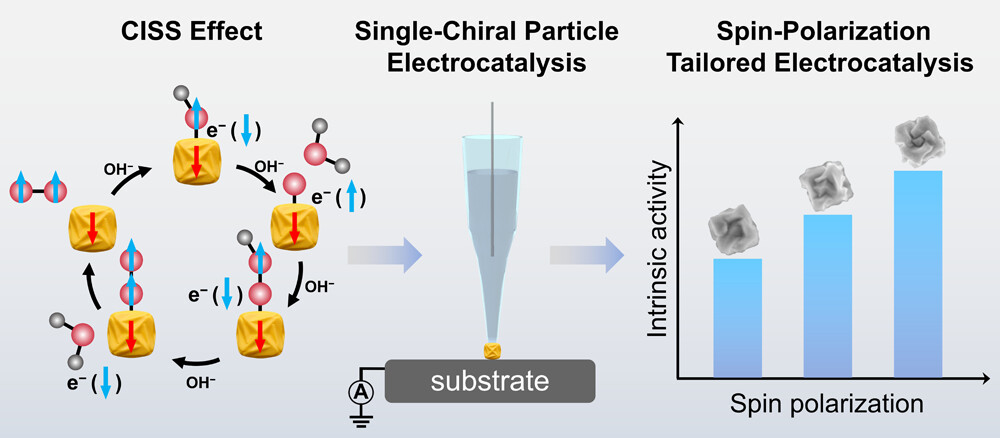
The oxygen evolution reaction (OER) is a key step in energy conversion technologies such as water electrolysis. Its slow kinetics are primarily limited by the complex four electron transfer and singlet–triplet spin transition. The chirality induced spin selectivity (CISS) effect, which polarizes electron spins, holds promise for lowering the reaction barrier. However, how chiral morphology quantitatively affects catalytic activity remains unclear. In this work, using chiral cysteine as a morphology director, the team synthesized D type, L type, and achiral gold nanocrystals with precisely tunable helical degrees (D Au I/II/III, L Au III, Rac Au III), and confirmed their uniform morphology and size by scanning electron microscopy. Subsequently, circular dichroism spectroscopy and magnetic mode atomic force microscopy (mc AFM) were employed to characterize their chiral optical activity and spin polarization (reaching −70.6% and 68.9% for D Au III and L Au III, respectively). On this basis, scanning electrochemical cell microscopy (SECCM) was used to measure the OER current at single nanocrystals.
Single particle measurements revealed that the average OER currents of chiral D and L type Au III (approximately 59 and 57 pA, respectively) were about 70% higher than that of achiral Rac Au III (approximately 34 pA). Moreover, as the helical degree increased from D Au I to D Au III, the activity increased progressively. One way analysis of variance indicated that the activity differences were highly statistically significant (p < 0.001). More importantly, after normalizing by particle surface area, the current densities of the three D type particles showed a linear positive correlation with their respective spin polarizations, directly confirming that the CISS effect is the origin of the catalytic enhancement. Bulk measurements validated the same trend, but the single particle approach avoided agglomeration and mass transport limitations and revealed inter particle activity heterogeneity. This work establishes, for the first time at the single particle level, a quantitative structure–activity relationship among “chiral morphology, spin polarization, and catalytic activity”, providing a new design strategy for the development of efficient spin selective electrocatalysts.
This research was supported by the National Natural Science Foundation of China. Huaxu Zhou, a Ph.D. candidate (Class of 2022) from the College of Chemistry and Chemical Engineering, is the first author of the paper. Professor Qianjin Chen is the corresponding author. Donghua University is the first corresponding institution. Collaborators include Dr. Yuxi Fang and Dr. Wanning Zhang from Shanghai Jiao Tong University.
Article DOI: 10.1021/acsnano.6c05258
Group website: https://www.x-mol.com/groups/qianjinchen2105