

Recently, the research group of Distinguished Research Fellow Weimin Xuan from the College of Chemistry and Chemical Engineering has made significant progress in the controllable assembly of high nuclear polyoxometalates (POMs). The related research findings, titled "Organophosphonate Ligation Approach for the Controlled Assembly of Gigantic Polyoxometalate Clusters," have been published in the Journal of the American Chemical Society (JACS), a top tier journal in the international chemistry community.
Polyoxometalates (POMs), as a unique class of discrete metal–oxo clusters, exhibit diverse structures and excellent physicochemical properties, making them highly promising for applications in catalysis, sensing, materials science, and biomedicine. High nuclear polyoxomolybdates (POMos), an important subclass of POMs, consist of hundreds of molybdenum centers and, based on their degree of reduction and structural building blocks, can be classified into molybdenum blues, molybdenum browns, and molybdenum reds. A variety of remarkable architectures have been successfully synthesized to date. However, the self assembly process of these gigantic molecules is highly dependent on subtle synthetic parameters, and precisely controlling the size, topology, and composition of the clusters through rational regulation of reaction conditions remains a formidable challenge in molecular self assembly. To address this challenge, the research group led by Weimin Xuan has innovatively employed an organophosphonate directed strategy, successfully synthesizing five novel high nuclear molybdenum blue clusters: {Mo₁₃₆}, {Mo₁₂₀}, {Mo₁₁₈}, {Mo₁₁₈Na}, and {Mo₁₅₇}. Among these, {Mo₁₅₇} represents the first pure dodecameric molybdenum wheel featuring a host–guest (cluster in cluster) architecture. This study provides deep insights into the regulatory mechanisms of competitive ligand coordination and reaction conditions on cluster assembly. It not only expands the structural library of high nuclear polyoxometalates but also establishes a new methodology for their controlled assembly. The resulting clusters exhibit excellent solution stability and solubility in organic solvents, and can be functionalized with biomolecules, laying a solid foundation for their applications in catalysis, biosensing, and beyond.
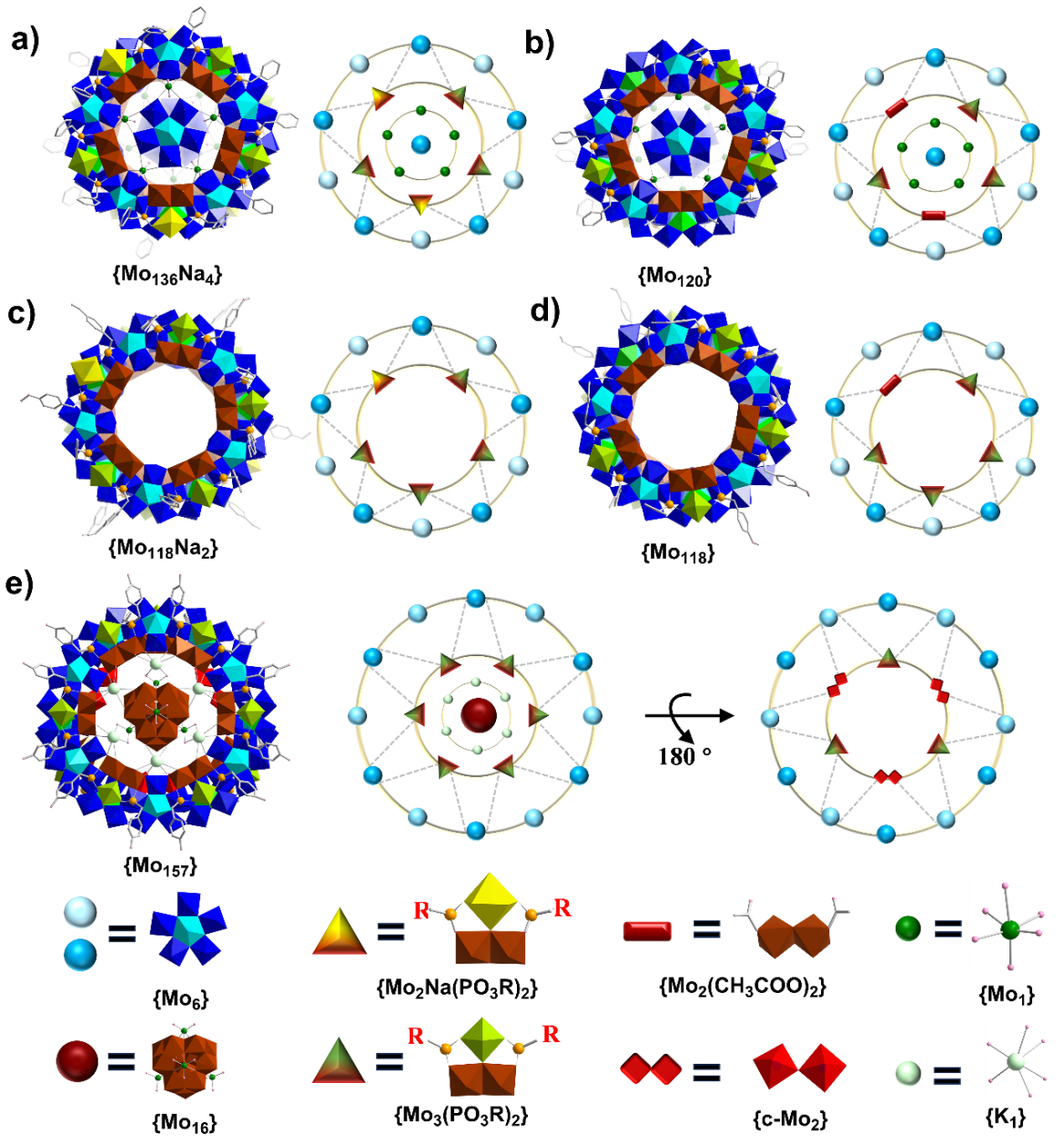
Figure 1. Structural evolution of organophosphonate directed wheel shaped molybdenum blue clusters.
The introduction of organophosphonate ligands not only enables precise structural synthesis but also significantly modifies the physicochemical properties of the clusters. Studies show that, compared to conventional inorganic molybdenum blue clusters, these new organofunctionalized POM clusters exhibit remarkably high solubility in a variety of polar organic solvents (e.g., isopropanol, acetonitrile, DMF). This breakthrough not only overcomes the limitation that traditional molybdenum blue clusters are difficult to handle in organic phases but also opens up new avenues for post synthetic modification of high nuclear POMs. The research team further confirmed the structural integrity of these gigantic assemblies in solution using electrospray ionization mass spectrometry (ESI MS) and ³¹P NMR spectroscopy. By reacting {Mo₁₅₇} with nucleotide molecules such as guanosine monophosphate (GMP), the team demonstrated that coordinated water molecules on the outer surface of the clusters can be successfully substituted, thereby achieving precise post synthetic modification of the peripheral microenvironment of molybdenum blue clusters. This provides experimental evidence and guidance for the future development of POM based biosensing platforms and for exploring their interactions with biomacromolecules.
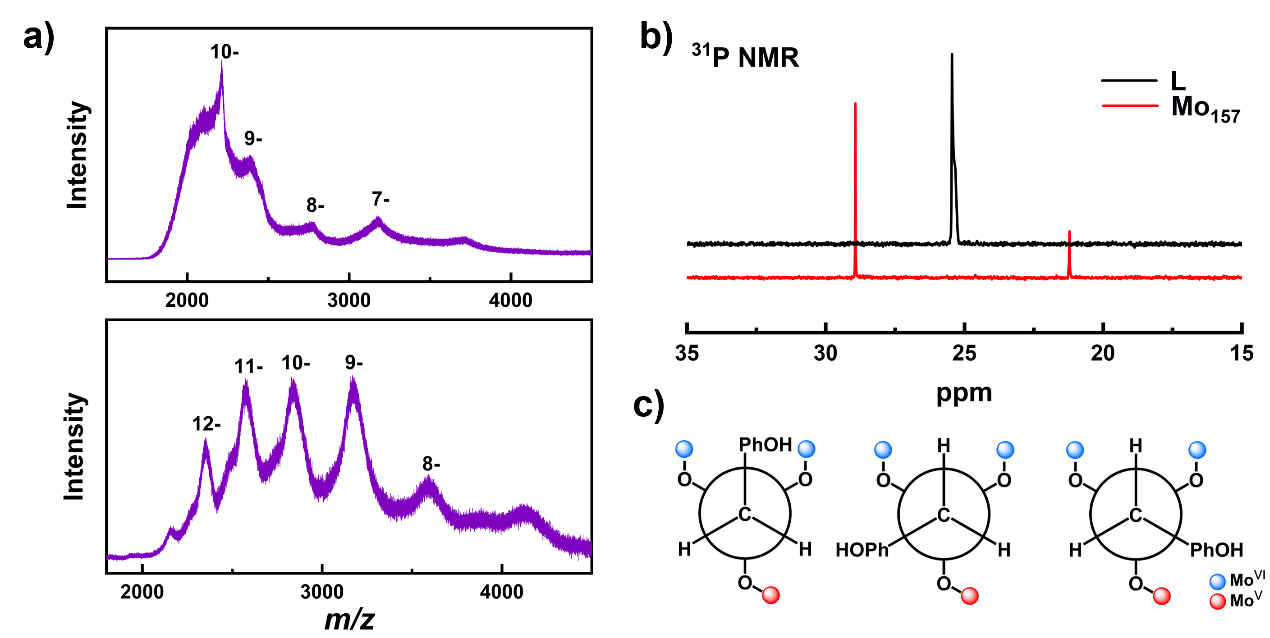
Figure 2. (a) ESI MS spectra of {Mo₁₁₈} and {Mo₁₅₇} in CH₃CN solution; (b) ³¹P NMR spectrum of {Mo₁₅₇} with hydroxybenzylphosphonate in D₂O; (c) Schematic representation of the three conformational isomers of the benzylphosphonate ligand.
Mengyuan Cheng, a Ph.D. student in the College of Chemistry and Chemical Engineering, is the first author of the paper. Distinguished Research Fellow Weimin Xuan (Donghua University), along with Professor Leroy Cronin and Professor De Liang Long (University of Glasgow), are the co corresponding authors. Donghua University is the first corresponding institution. This work was supported by the National Natural Science Foundation of China, the Program for Professor of Special Appointment (Eastern Scholar) at Shanghai Institutions of Higher Learning, and the Interdisciplinary Frontier Innovation Team Development Special Fund of Donghua University. The Testing Platform of the College of Materials Science and Engineering at Donghua University and the Shanghai Synchrotron Radiation Facility provided technical support for crystallographic data collection.
Paper link: https://doi.org/10.1021/jacs.5c21427