

Recently, the research team led by Researcher Cai Dongqing from the College of Environmental Science and Engineering has made significant progress in the field of rapid humification of food waste. The findings have been published in the international journal Nature Communications (2026).
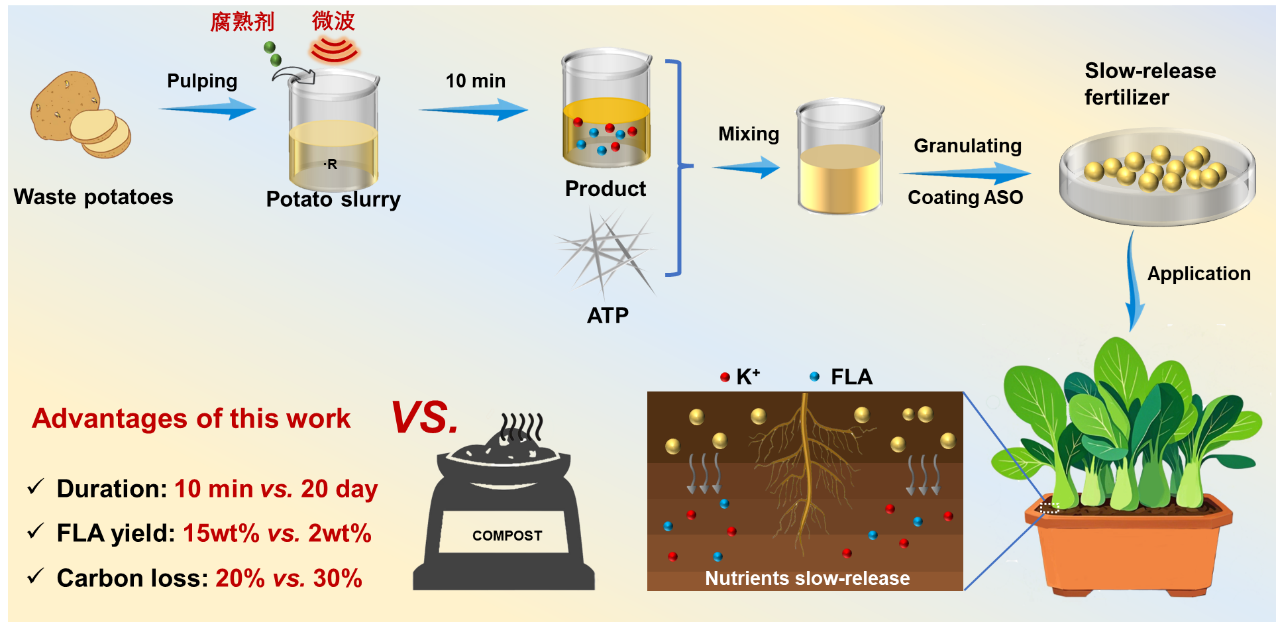
Fig. 1: Minute-scale humification of waste potatoes and recycling of the fertilizer.
Food waste is a major global issue due to its large volume and rapid putrefaction. Although composting is a common recycling method, its long processing time (20-60 d) drives the need for more efficient fertilization technologies. This study demonstrates rapid humification of waste potato (WP), as a model food waste, into fulvic-like acid (FLA) fertilizer (15 wt% FLA and 7.6 wt% K+) using microwave-triggered KOH/persulfate (MW/KOH/PS) process. Under synergistic MW irradiation (180 W) and KOH (2 wt%), PS (2 wt%) is activated to generate •OH and •SO4-. This process simultaneously dissolves organic matter and elevates system temperature, inducing humification of organic components within 10 min. Compositional analyses revealed Maillard reactions and amidation during humification. Compared to KOH/PS, microwave intensification reduces chemical consumption by 75%, while achieving comparable FLA yields and significantly lowering cost by 62.4%. Pot experiments validates the plant-growth promotion and soil-amendment capabilities of the humified product. Scale-up trials confirm the efficacy for practical vegetable residues and cooked food waste. Unlike composting, this process completes in 10 min without requiring optimal C/N ratio or moisture content, exhibited only 20.1% carbon loss (WP system), and operates in scalable reactor, thus enabling same-day waste valorization into fertilizer.
The rapid humification technology has been licensed to eight companies, leading to the establishment of a production line with an annual capacity of 400,000 tons of rapid humification fertilizer. This technology has received five awards. Additionally, the key mechanisms have been elucidated, with previous related research findings published in in three papers in Nature Communications.
Paper link:https://doi.org/10.1038/s41467-026-68295-6