

A research team led by Professor LIU Xiangjun from the College of Mechanical Engineering, DHU has made significant progress in the field of memristor-based brain-inspired chips. Their findings, titled Unveiling the role of grain boundaries in driving in-plane conductive filament formation in MoS2 neuromorphic devices, were published in Applied Physics Letters, a renowned journal in the field of physics. Recognized for its innovation and academic impact, the paper was selected as a Featured Article and highlighted as the journal's cover story. The College of Mechanical Engineering at Donghua University is the primary affiliation, with Ph.D. candidate SUN Jisheng as the first author and Professor LIU Xiangjun as the corresponding author.

To meet the demand for low-power, high-efficiency computing hardware in artificial intelligence, brain-inspired chips have emerged as a key direction to overcome the limitations of the traditional von Neumann architecture. Memristors are core components in building brain-inspired chips, with their performance depending on the mechanisms underlying the formation and regulation of conductive filaments. This study systematically reveals the critical role of 4|6 grain boundaries in MoS2 in driving the formation of conductive filaments within memristors for brain-inspired chips, elucidating the mechanisms of conductive filament formation and migration at the atomic scale. The findings provide important theoretical support for the design of two-dimensional material-based memristors and brain-inspired chips, and hold significant implications for advancing novel artificial intelligence hardware.
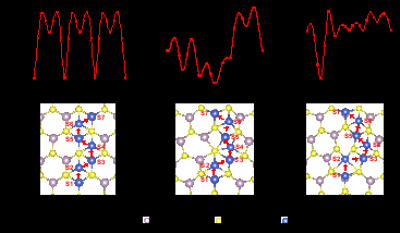
(Migration paths and energy barriers of Cu atoms in different types of MoS2)
Paper link: https://doi.org/10.1063/5.0302223