

Recently, the research team led by Researcher Yan Jianhua from the College of Textiles, DHU has made new progress in the study of visible-light-driven degradation of organic pollutants. The related findings have been published in the international journal Advanced Materials (2025, e13684) under the title “Constructing 0D Bismuth‑Metal Nanosphere Networks on 1D/2D Bi₂WO₆ Heteromorphic Junctions for Efficient Photocatalytic Degradation of Acetaldehyde”.
Semiconductor photocatalysis holds great potential for the degradation of volatile organic compounds (VOCs), yet photocatalysts often experience low efficiency due to insufficient surface catalytic active sites, limited light absorption, and poor carrier separation efficiency. Inspired by the structure of Eucalyptus trees, a selective reduction strategy is proposed to grow bismuth nanosphere networks on 1D/2D Bi2WO6 (BWO) heteromorphic junctions, which consist of interwoven mesoporous nanofibers (NFs) and nanosheets (NSs). This establishes a synergistic mechanism of “surface active sites-intrinsic defects-carrier separation”. Initially, the electrospun BWO precursor NFs are calcined in air, resulting in 2D NSs growing radially along the NFs in an ordered, spaced arrangement to form 1D/2D BWO structures. Subsequently, under H2/Ar reduction, Bi3+ species are preferentially reduced to Bi0 along the NF axes and NS corners, forming a dynamically evolved metal-defect regulatory system. The 0D/1D/2D Bi-BWO photocatalyst can rapidly degrade 100% of acetaldehyde and exhibits superior stability over five cycles. Its degradation rate is 3.5 times faster than that of 1D/2D BWO and significantly surpasses traditional BWO. This work presents a novel perspective for designing photocatalysts to efficiently remove VOCs.
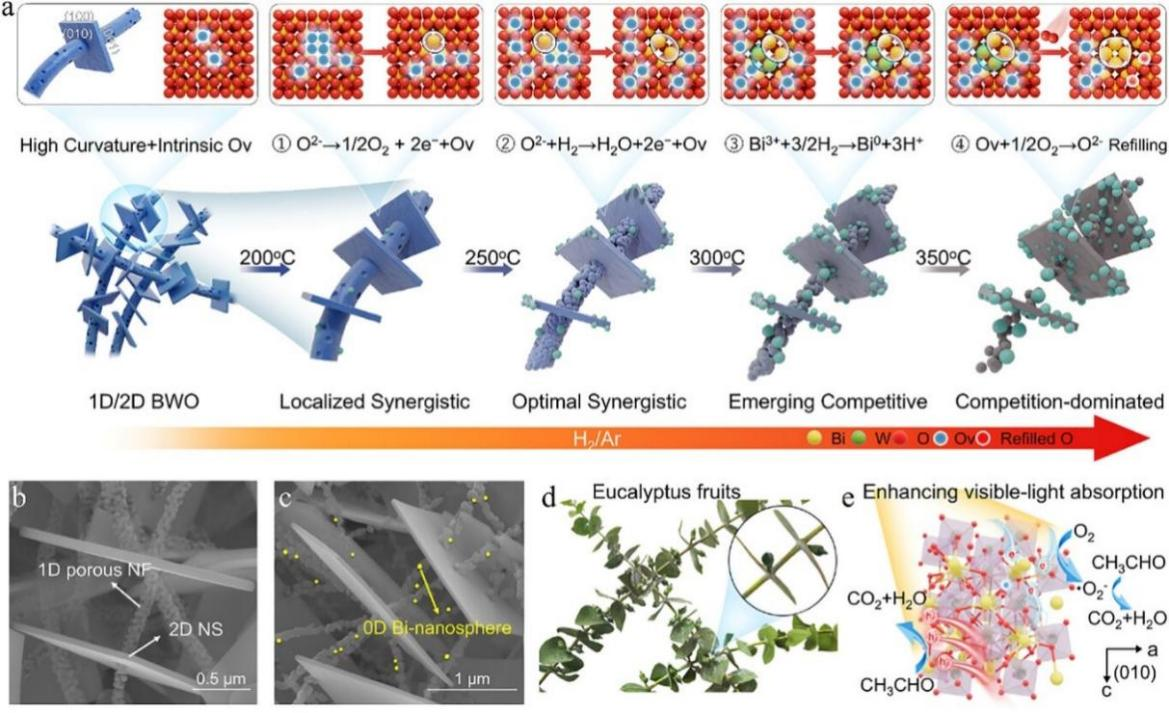
Synthesis of 0D/1D/2D Bi-BWO-X photocatalysts and the enhanced photocatalytic acetaldehyde degradation mechanism
Link to the paper:https://doi.org/10.1002/adma.202513684