

Recently, a joint research team led by Wu Peiyi and Sun Shengtong from the College of Chemistry and Chemical Engineering and the Advanced Low-Dimensional Materials Center at DHU has made significant progress in the study of Stiffening of Transient Hydrogels. The related findings were published in Angewandte Chemie International Edition (2025, 64, e202518064) under the title Chemical Fuel-Driven Stiffening of Transient Hydrogels via Vitrifiable Phase Separation.
In this paper, the research team introduces a novel strategy that couples vitrifiable phase separation with non-equilibrium chemistry to significantly enhance the mechanical properties of transiently stiffened materials. Unlike traditional transient materials, which are based on either supramolecular assemblies or relatively homogeneous structures, our synthesized P(AA2Zn-co-AA) copolymer hydrogel features a thermal-stiffening bicontinuous phase separation. The addition of EDC triggers the transient conversion of AA units into hydrophobic anhydrides, which dramatically reduces the stiffening temperature. This leads to the instant vitrification of polymer-rich phase, transforming the initial soft hydrogel into a stiff glassy state with an ultrahigh modulus of 115 MPa. The stiffened modulus is unparalleled among current artificial transient materials. Furthermore, the lifetime of this transient hydrogel can be finely tuned by adjusting EDC concentration. We anticipate that, this phase separation-mediated non-equilibrium chemistry will pave the way for creating advanced transient materials that more precisely mimic living systems.
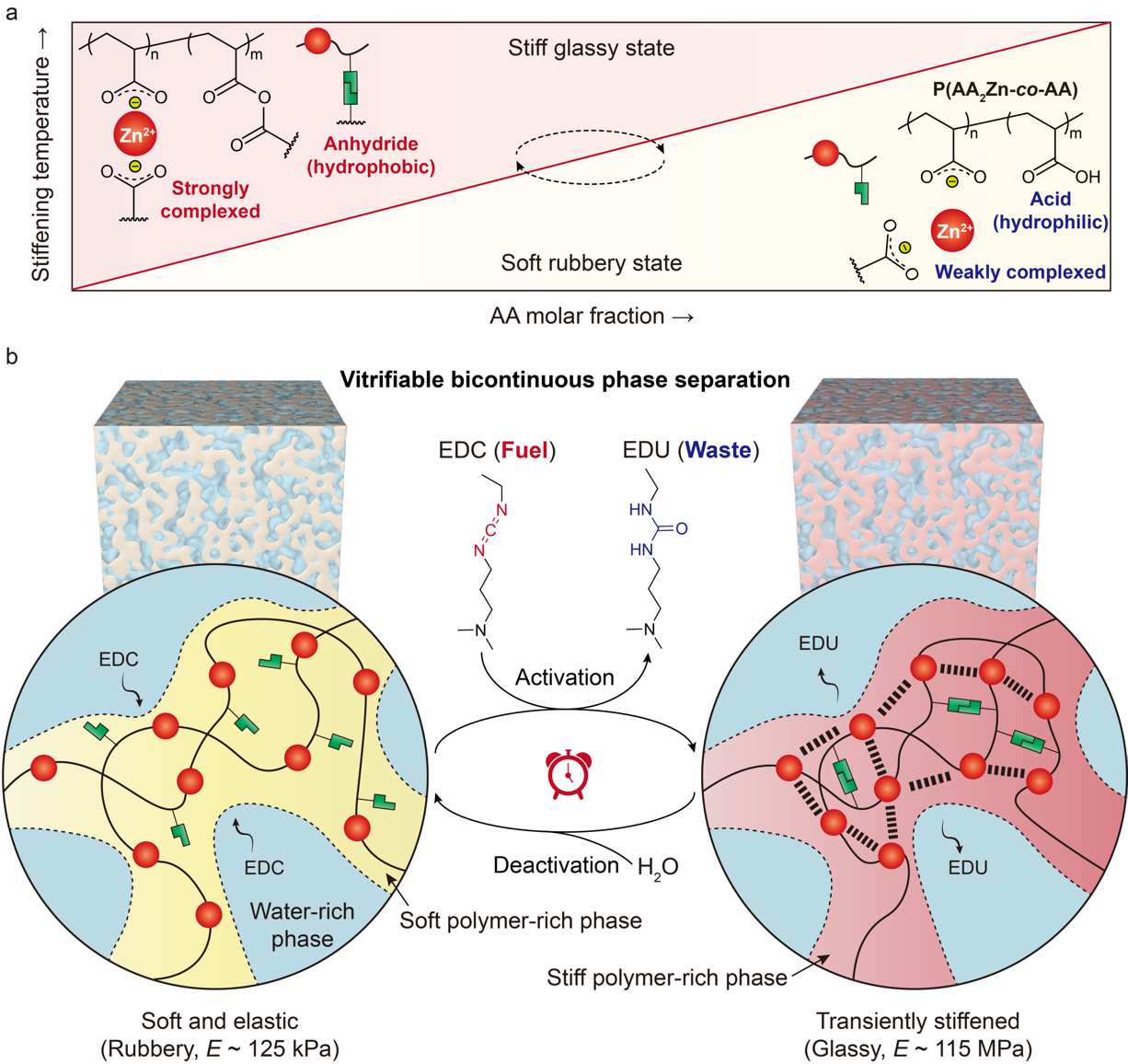
Fig.1 Working mechanism of chemical fuel-driven dramatic stiffening of transient hydrogels.
Paper link: https://doi.org/10.1002/anie.202518064