

A research team from Donghua University, led by Researcher Mao Zhiping and Researcher Xu Hong of the College of Chemistry and Chemical Engineering, has recently made a significant breakthrough in the field of passive radiative cooling. Their latest findings, published in Advanced Materials (2025, e11445) under the title “Self-Switching Dynamic Infrared Radiative Cooler Enabling Triple-Mode Temperature Regulation”, offer a new pathway for zero-energy thermal management.

Passive radiative cooling, an emerging technique that requires no additional energy input, has long been considered a promising solution for sustainable temperature regulation. However, the performance of traditional static radiative coolers is constrained by their inadequate adaptability to fluctuating thermal conditions. Different environments often demand drastically different, even conflicting, infrared emission characteristics, restricting the practical use of such materials in buildings, wearable systems, and electronic devices.
To overcome this long-standing bottleneck, the Donghua University team proposed an innovative concept: the “self-switching dynamic infrared radiative cooler.” The core advancement comes from harnessing the temperature-responsive, directional migration of broadband-emitting water molecules within specially engineered hydrogels. This mechanism allows the material to automatically switch between two spectral states. Below ambient temperature, it enters a selective infrared emission state, achieving efficient cooling, and above ambient temperature, it transitions to a broadband infrared emission mode, enhancing heat dissipation.
Laboratory experiments validated the material’s versatility across multiple application scenarios. The dynamic infrared radiative cooler achieved 9.5 °C cooling below ambient temperature for building thermal management, 7.0 °C cooling for personal thermal regulation, and 6.9 °C enhanced heat dissipation for electronic device cooling. This tri-modal functionality demonstrates unprecedented flexibility and adaptability in zero-energy temperature control.
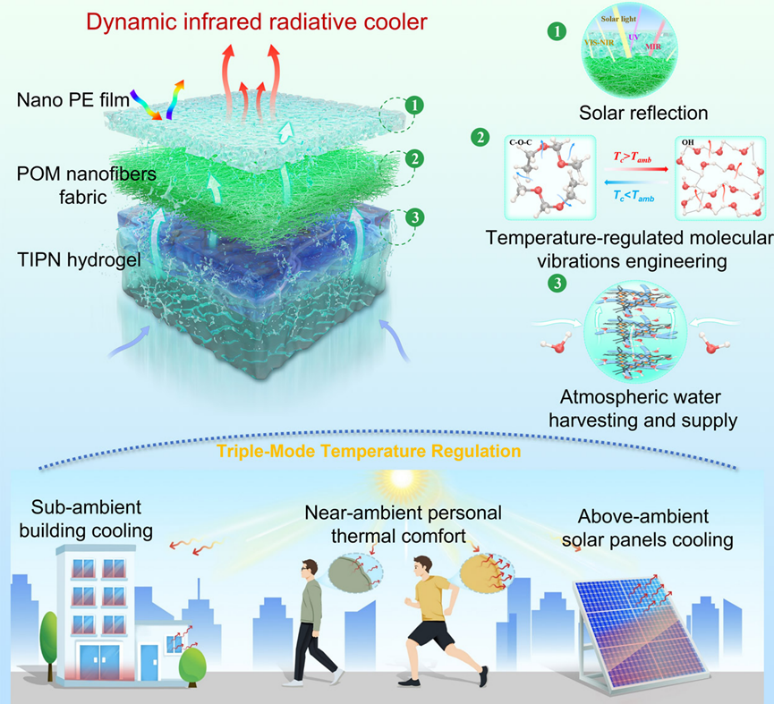
Figure 1. Design principle of triple-mode temperature regulation realized by dynamic infrared radiative cooler
The research team led by Researchers Mao Zhiping and Xu Hong have long focused on green, low-carbon textile printing and dyeing technologies. Their latest achievement not only breaks through the constraints of traditional static radiative coolers, namely single-scenario limitations and poor climate adaptability, but also provides a cost-effective, zero-energy solution for multi-scenario thermal management aligned with global carbon neutrality goals.