

A research team led by Researcher Liao Yaozu from the School of Materials Science and Engineering has achieved a major breakthrough in developing ionic composite materials for the efficient capture of radioactive anions, a critical step toward advancing China’s nuclear resource recycling technologies.
Radioactive nuclides, of which around 60 occur naturally and more than 2,000 are artificially synthesized, play indispensable roles in industrial testing, nuclear energy production, and deep space exploration. However, efficient separation and recycling technologies for these nuclides remain a key bottleneck in China’s nuclear resource recovery system. Overcoming this challenge is essential for ensuring national resource security and promoting the sustainable development of nuclear energy. Among these nuclides, technetium-99 (⁹⁹Tc) stands out for its high toxicity, high yield, and long-lived radioactivity, with a half-life of about 2.13 × 10⁵ years. In nuclear waste, it mainly exists as pertechnetate ions (⁹⁹TcO₄⁻), which are highly mobile in the environment and can easily enter the food chain once released. To address this issue, Liao’s team designed an innovative approach to improve the adsorption and capture efficiency of such anions. Building upon the high specific surface area of metal–organic frameworks (MOFs), the researchers introduced cationic polymers into MOF structures, creating ionic polymer–MOF composite materials capable of binding radioactive anions. Traditional preparation methods often suffer from polymer entanglement, low loading capacity, and poor exposure of active sites. To overcome these limitations, the team proposed a novel “in situ molecular weaving” technique, enabling ordered and confined growth of polymer chains within MOF pores. The resulting materials exhibit a regular structure and remarkable adsorption performance.
Their research, titled “In situ molecular weaving of ionic polymers into metal–organic frameworks for radioactive anion capture,” was recently published in Nature Communications (2025, 16, 7393). Li Xinghao, a doctoral student at the university, is the first author, and Researchers Liao Yaozu and Zhang Weiyi are the corresponding authors.
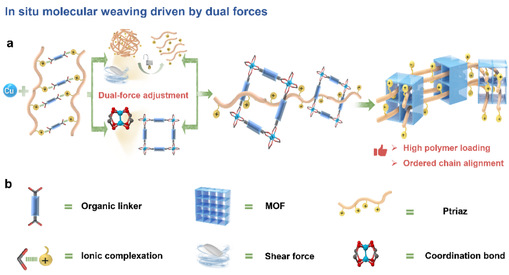
Construction of Ionic Polymer-MOF Composites via Molecular Weaving Induced by Dual Forces
In this study, the team developed an in situ molecular weaving strategy that uses the synergistic action of shear forces and coordination bonds to disentangle and align cationic polymer chains within MOF nanochannels during the material’s formation. This process ensures a uniform polymer distribution and optimizes structural stability. The resulting molecularly woven polymer–MOF composites (MW-Ptriaz@MOF) demonstrated an exceptional adsorption capacity of 438 mg/g for rhenate ions (ReO₄⁻)—a non-radioactive analog of pertechnetate (⁹⁹TcO₄⁻)—reaching adsorption equilibrium within 20 minutes. Even under strongly acidic conditions and in the presence of 100-fold excess competing anions, the materials maintained outstanding selective adsorption performance.
The innovative “in-situ molecular weaving” strategy not only establishes a novel avenue for the structural modulation and performance enhancement of multifunctional composite adsorbent materials, but also provides a solid theoretical foundation for the future design of high-performance ion-based composite materials.