

Recently, the research group led by Dr. Du Linglong, a young faculty member from the School of Mathematics and Statistics at DHU, published a paper entitled “TwoSparse Control Strategies for the Delayed Heterogeneous Cucker–Smale Model” in the internationally renowned journal SIAM Journal on Control and Optimization. This paper provides a new theoretical framework for analyzing the dynamic behaviors and designing control strategies of swarm intelligence systems, showcasing progress in the interdisciplinary field of artificial intelligence.
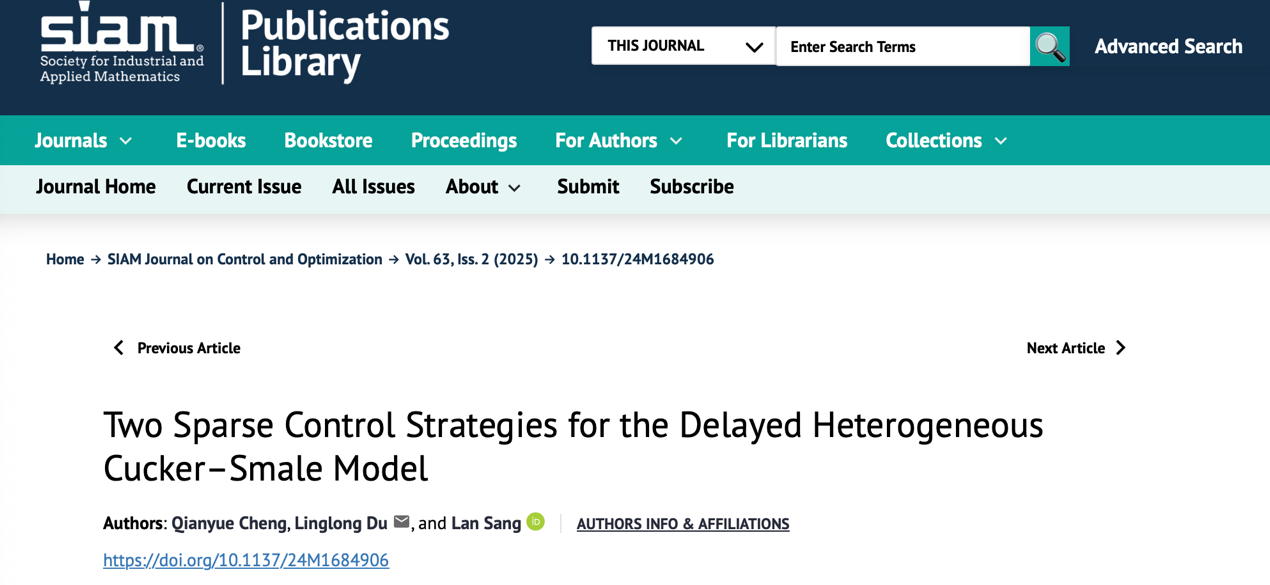
The paper establishes a general swarm intelligence model incorporating both time delay and heterogeneous interactions, offering a deep mathematical analysis of group dynamics and proposing two novel sparse control strategies. The findings enrich the mathematical theory of delayed heterogeneous systems and have direct practical significance for applications such as UAV formation trajectory tracking and multi-robot cooperative operations.
As a frontier research area in distributed decision-making and coordination, swarm intelligence relies heavily on the mathematical understanding of its underlying mechanisms, which is key to overcoming real-world application bottlenecks in multi-agent systems. Dr. Du’s research group has long been devoted to modeling, theoretical analysis, and application of collective intelligent behaviors, forming a coherent body of systematic research outcomes. In 2025, the Applied Mathematics and Artificial Intelligence Interdisciplinary Research Team has published six papers in internationally leading journals such as J. Differential Equations, Automatica J. IFAC and SIAM Journal on Control and Optimization, continuously advancing the integration of artificial intelligence and applied mathematics.
The School of Mathematics and Statistics at DHU attaches great importance to research team development and interdisciplinary integration, providing high-quality research platforms for young scholars. Moving forward, the college will continue to support research teams in exploring frontier fields such as artificial intelligence, injecting strong momentum into serving national strategic needs and promoting the high-quality development of fundamental disciplines.
Paper link:https://epubs.siam.org/doi/10.1137/24M1684906