

The water cycle not only sustains the freshwater resources essential for human survival but also harbors immense potential for energy harvesting and strategic material extraction. Achieving clean water production, sustainable energy generation, and critical metal recovery under limited freshwater and high-salinity conditions has become a key challenge in the field of green energy under the carbon peaking and carbon neutrality goals. Existing desalination and lithium extraction technologies often face significant challenges, including high energy consumption, excessive water use, and difficulties in process integration.
To address these challenges, Professor Hongzhi Wang and Researcher Chengyi Hou from the College of Materials Science and Engineering at DHU, have proposed an innovative strategy termed “evaporation-driven functional fabric.” By regulating interfacial charge asymmetry and coupling a multilayered structural design, the research team successfully realized the synergistic co-harvesting of water, electricity, and lithium driven by evaporation.
Recently, the research results, entitled “Evaporation-Driven Fabric for Synergistic Water–Electricity–Lithium Co-Production,” were published in the international journal Advanced Materials.
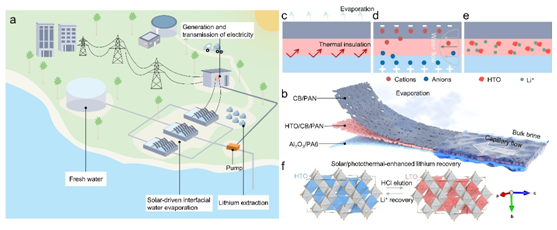
(Evaporation-driven functional fabric integrates solar steam generation, continuous power output, and efficient lithium extraction through a tri-layer synergistic design)
The study demonstrates that the evaporation-driven functional fabric achieves the integrated utilization of water, electricity, and lithium within a single textile platform through a three-layer synergistic design. The carbon black (CB) photothermal layer efficiently absorbs solar energy and drives water evaporation, producing clean freshwater. The protonated lithium titanate (HTO) adsorption layer realizes high selectivity in lithium capture through its unique ion-sieving properties, while the Al₂O₃ thermal insulation layer effectively minimizes heat dissipation, ensuring stable and efficient system operation. The charge-asymmetric interfaces among these layers induce a stable hydrovoltaic effect during the evaporation process, enabling the fabric to continuously generate electricity.
Under simulated salt lake brine conditions, the fabric achieved an evaporation rate of 1.42 kgm⁻² h⁻¹, a steady current density of 7.7 µAcm⁻², and a lithium adsorption capacity of 40.87 mgm⁻², maintaining 93.2% recovery efficiency after eight cycles. Outdoor experiments further confirmed that the fabric can simultaneously produce freshwater and extract lithium during eight hours of continuous sunlight exposure, while successfully powering low-power sensors. The collected freshwater meets the WHO drinking water standards, highlighting the fabric’s potential for practical application in sustainable energy and resource systems.
The research realizes the integrated and synergistic utilization of water–electricity–lithium within a multifunctional textile platform, offering a novel technological route to address the dual challenges of desalination and critical resource recovery from salt lakes and seawater. The developed functional fabric not only opens new possibilities for the sustainable development of green energy and strategic materials but also establishes a theoretical foundation for designing future intelligent systems that couple energy, environment, and resource utilization.
Paper Link:https://advanced.onlinelibrary.wiley.com/doi/10.1002/adma.202506956