

The world’s first academic monograph dedicated to the in-vivo failure analysis of textile-based cardiovascular devices—Cardiovascular Explants: Biofunctionality, Biodurability and Biocompatibility—has been officially released by Springer Nature, a globally recognized academic publisher. The publication marks the milestone achievement of a 25-year international collaborative research program between Donghua University (DHU) and Laval University, establishing a new benchmark for the clinical evaluation of cardiovascular explants.
Jointly authored by 62 experts from 8 countries, the 11-chapter monograph is led by Professor Wang Lu (Donghua University), Professor Robert Guidoin (Laval University) and Professor Zhang Ze (Laval University). Seven DHU faculty members (including Wang Lu, Wang Fujun and Lin Jing), together with more than ten doctoral and master’s researchers from the Biomedical Textiles Research Team, contributed to this comprehensive work. Integrating interdisciplinary expertise in clinical medicine, biomaterials, textile engineering, and pathology, the team has developed the first full life-cycle evaluation framework for cardiovascular implants, supported by over 440 figures, 30+ analytical tables, and more than 1,400 references.
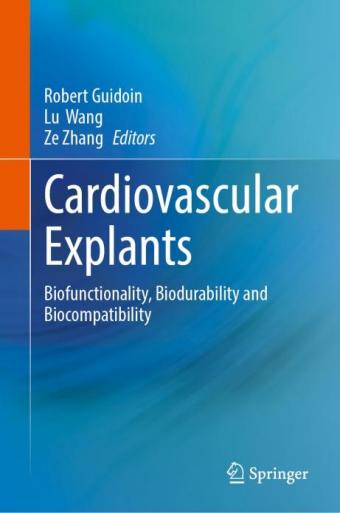
The key innovative contribution of this monograph lies in the proposal of “3Bs” theoretical framework, which refers to the three core evaluation criteria: Biofunctionality, Biodurability and Biocompatibility. Based on extensive research on the retrieval of human implants, the team has confirmed that traditional bench tests, animal experiments and clinical trials can hardly truly reflect the actual performance of devices in the human body. This research fills the critical gap in the global database on the long-term in-vivo service of textile-based medical devices, and provides important theoretical support and practical guidance for relevant fields.
The monograph introduces the original “3Bs” theoretical system—Biofunctionality, Biodurability, and Biocompatibility—as the core criteria for assessing implant performance in the human body. Through extensive analyses of retrieved human implants, the research confirms that traditional bench testing, animal studies, and clinical trials alone are insufficient to accurately reflect real in-vivo device behavior. This work fills a critical gap in global knowledge regarding the long-term performance of textile-based medical devices and provides a foundational reference for clinical evaluation, regulatory standards, and future device design.
The academic significance of this publication has been widely acknowledged by the international community. The foreword of the monograph was jointly written by Professor Frederick J. Schoen, President of the International Society for Applied Cardiovascular Biology and Professor at Harvard Medical School, and Professor Jing Zaiping, a pioneer of endovascular surgery in China. They highlight the historical lineage from the early independent development of cardiovascular devices at Shanghai Chest Hospital in the 1980s to today’s model of transformative Sino-Canadian scientific collaboration. As emphasized by Professor Guidoin, the future of medical device innovation must be patient-centered, redefining the core logic of technological development. This philosophy is deeply reflected throughout the monograph, representing a harmonious integration of scientific rigor and medical humanism.
Building on Donghua University’s world-class strengths in textile science and engineering, the Biomedical Textiles Research Team has effectively leveraged its specialized technical expertise—particularly at a time when North America faces a significant talent gap in textile engineering. The team has successfully addressed key technical challenges in fabric-covered vascular stents, including blood leakage resistance and pulsatile fatigue durability. As emerging technologies such as biodegradable and renewable biomaterials continue to advance, the evaluation framework established in this monograph is expected to further guide the development of cardiovascular implants toward greater safety, durability, and intelligent functionality. Looking forward, the team will further advance interdisciplinary medical-engineering innovation, contributing Chinese solutions to global challenges in precise and intelligent cardiovascular repair.
E-book Access:
https://link.springer.com/book/10.1007/978-3-031-85504-7