

On May 27, DHU held a release ceremony for the outcomes of its barrier-free design course at Shimen Road Number Two Sub-district in Shanghai's Jing'an District. As an innovative initiative integrating industry, academia, and research, the course attracted industry experts, community representatives, and 53 participating students.
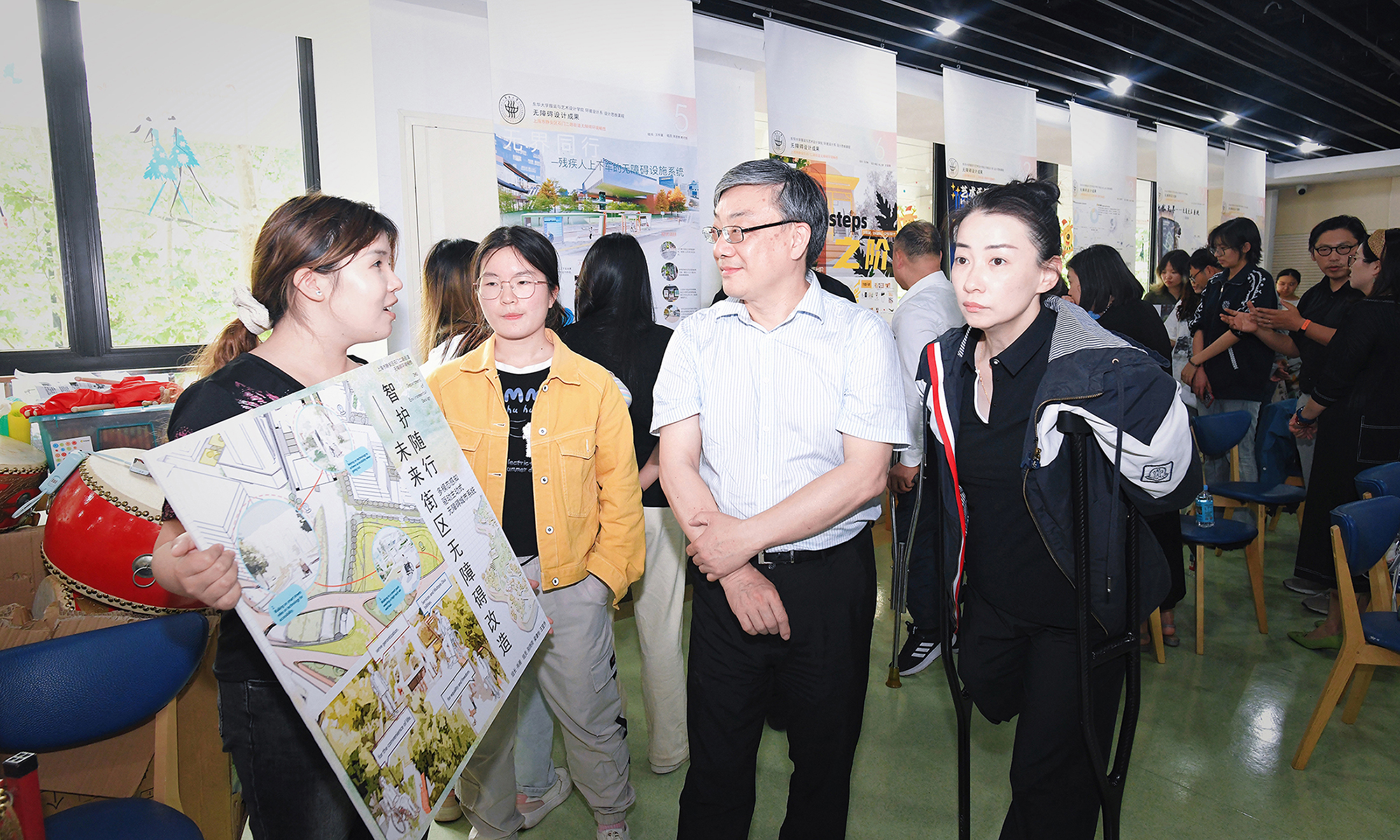
(Students present their design proposals)
The course focuses on “Barrier-Free Environment Design Thinking” and follows a seven-step process: “Insight, Definition, Development, Design, Implementation, Use, and Feedback,” along with six key components: “Expert Sharing, Task Interpretation, Site Research, Brainstorming, Design Proposals, and Roadshow Presentation.” During the roadshow and outcome presentation, 15 student teams showcased their innovative barrier-free design projects. These covered six categories, including “Street Spaces,” “Community Spaces,” “Stairwell Spaces,” “Digital Interaction,” “Future Neighborhoods,” and “Transportation,” and addressed 12 design directions such as “Paving and Landscaping,” “Tactile Ground Innovation,” “Street-Side Businesses,” “Bus Stops,” “Art Installations,” “Pedestrian Systems,” “Road Intersections,” “Neighborhood Landscapes,” “Stairwell Renovations,” “Accessibility Apps,” “Community Accessibility Facilities,” and “Accessible Wayfinding Systems.”
As Shanghai’s first community-university collaborative barrier-free design course, the project significantly enhanced students’ design skills and sense of social responsibility, while contributing innovative solutions to the development of an inclusive urban environment.
According to data released by the National Bureau of Statistics, as of 2023, China had a total of 85.91 million persons with disabilities, accounting for 6.34% of the national population, with a significant proportion living in urban areas. As society continues to develop and the demand for a higher quality of life grows, the construction of barrier-free urban environments has become an important indicator of both urban civility and social inclusiveness. Barrier-free design not only directly affects the daily lives of persons with disabilities, but also benefits other vulnerable groups such as the elderly, pregnant women, and children. The course’s innovative practices offer fresh momentum for advancing inclusive urban development.