

Underwater adhesives have garnered significant attention due to their vital roles in various fields such as underwater coating, underwater actuators, and surgery. However, developing underwater adhesive materials that offer both high strength and durability remains a major challenge. Supramolecular adhesives, which are currently under extensive development, show broad application prospects. Compared to traditional polymer adhesives, they exhibit better wettability, enabling effective spreading on different material surfaces. Moreover, under external stimuli, they can achieve reversible adhesion, thereby fully leveraging their recyclability and sustainability.Recently, a research team led by Professor Wu Peiyi and doctoral student Liu Kai has developed ionic liquids (ILs) as underwater adhesives directly via a fluorinated and branched modification strategy. The subsequent self-assembly of these ILs promotes the formation of robust hydrophobic supramolecular polymeric networks, thus effectively driving both high cohesion and outstanding underwater interfacial adhesion.
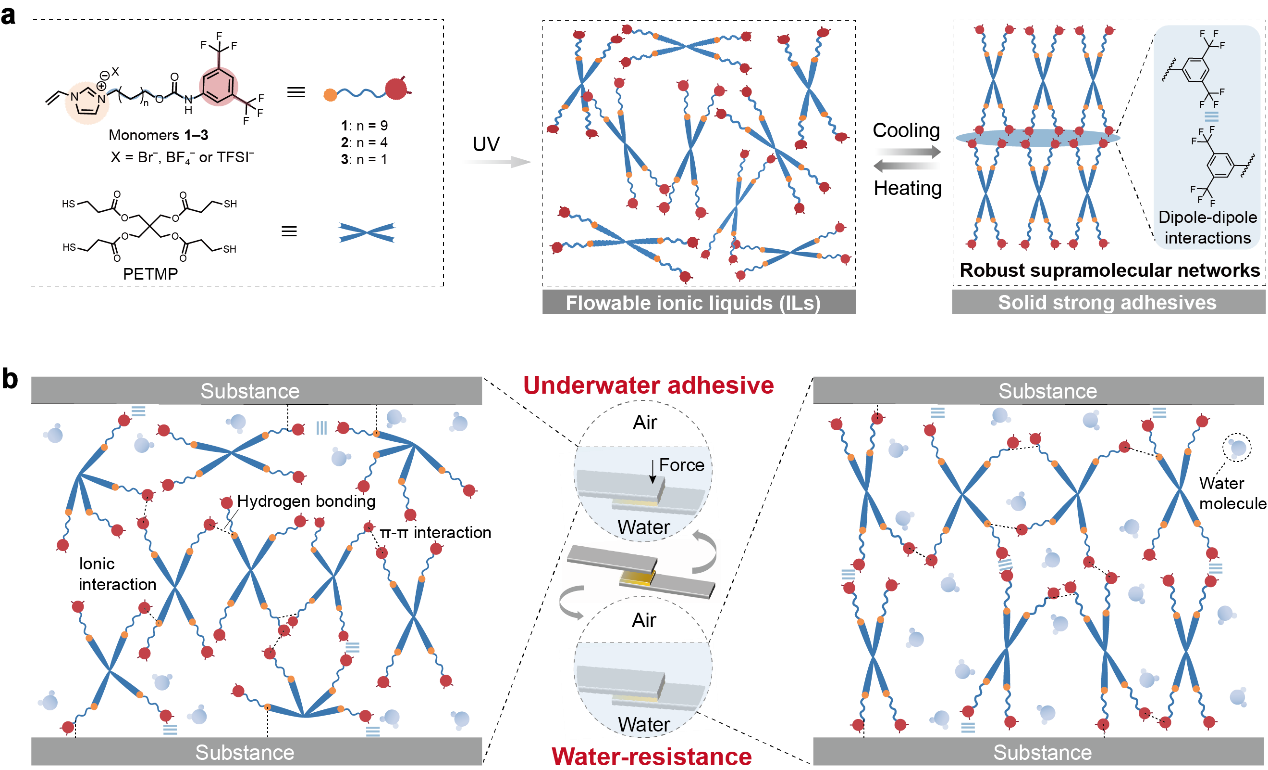
Pic.1 The design strategy and diagram of underwater adhesion process
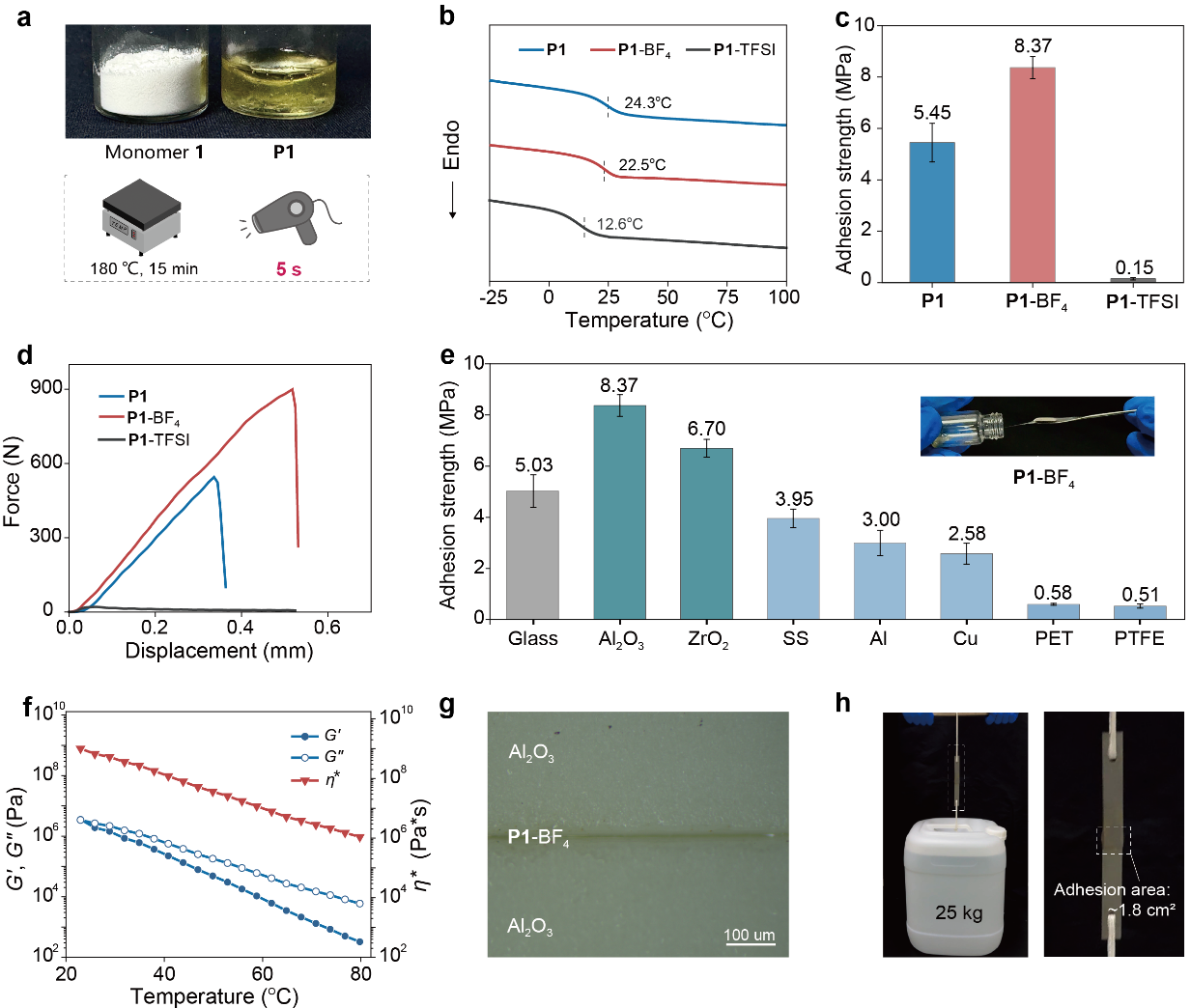
Pic.2 Thermomechanical properties and adhesion performance.
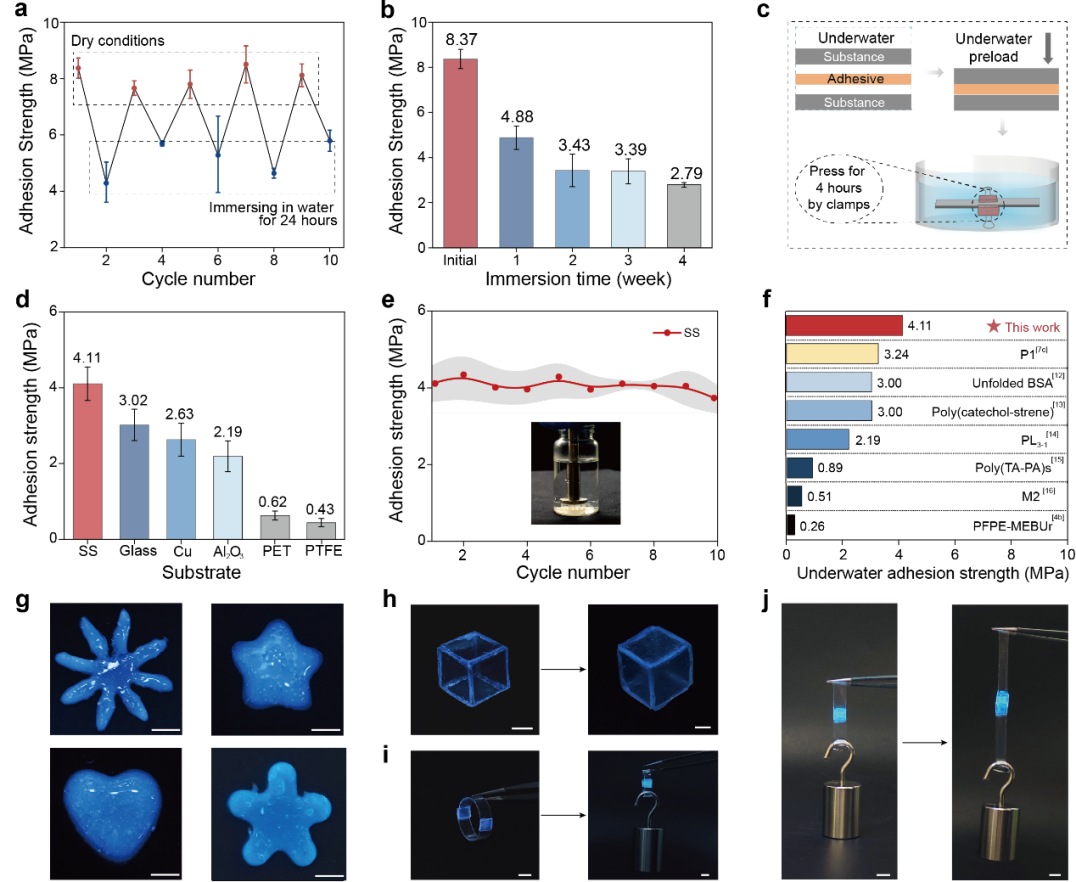
Pic.3 Recycling performance, underwater adhesion performance and performance comparison
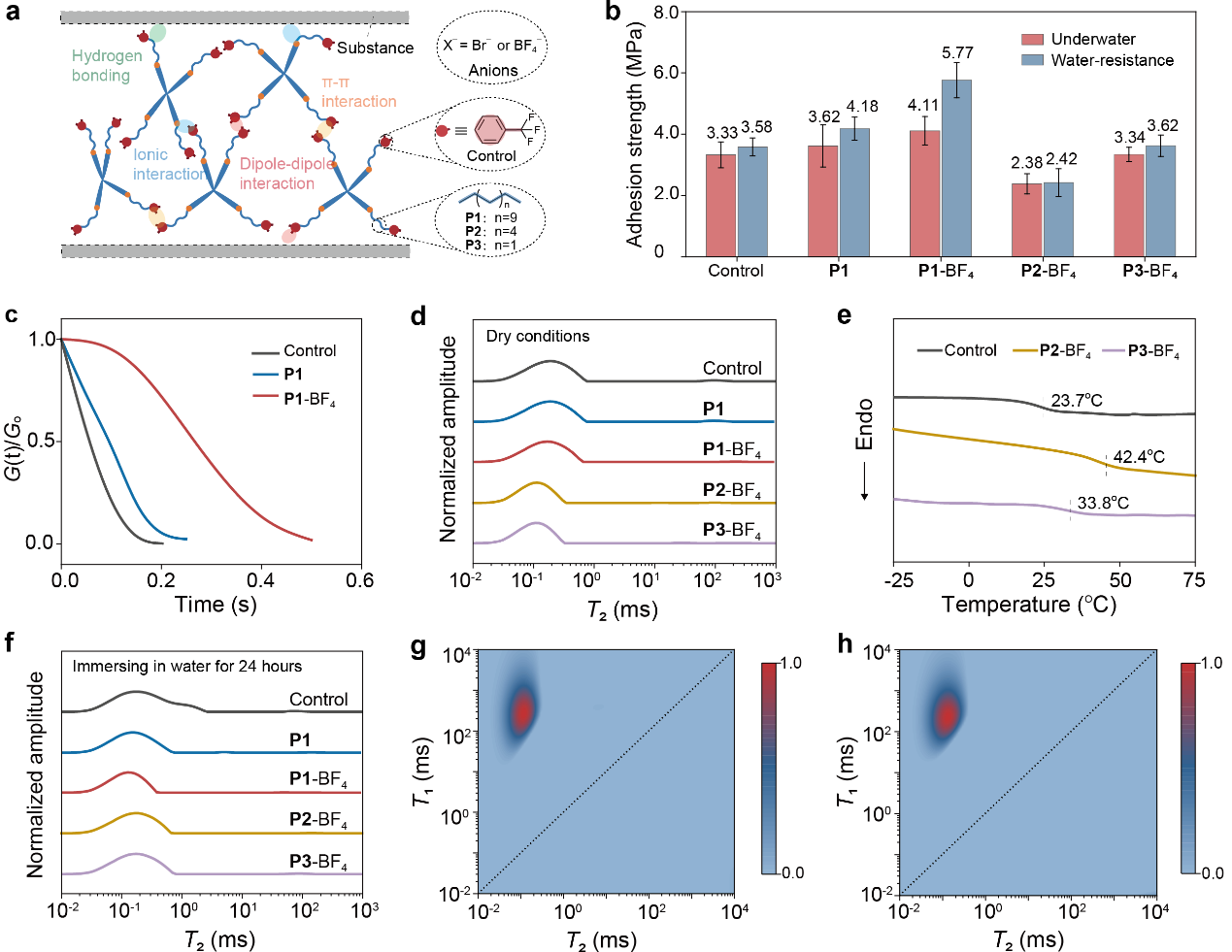
Pic.4 Fundamental understanding of molecular mechanism
The research team designed a series of IL-based underwater supramolecular adhesives via utilizing fluorinated ILs. Enabled by robust hydrophobic supramolecular polymeric networks formed through abundant noncovalent interactions (dipole‒dipole, cation‒π and π‒π interactions etc.), these ILs exhibit high cohesion and excellent interfacial adhesion underwater, effectively preventing the adhesion failure caused by water. As a result, our supramolecular modification strategy addresses the trade-off between dynamic features and high-performance underwater adhesion of supramolecular adhesives, while also offering good cyclability and blue fluorescence. To validate our supramolecular strategy, reseaarchers fabricated various hydrogel assemblies, demonstrating excellent underwater properties of our IL-based adhesives. Moreover, these adhesive ILs serve as a model system to gain a deeper understanding of high-performance underwater properties, especially the molecular mechanism. We anticipate that our IL-based underwater adhesive will help shape the future of supramolecular adhesives and provide a new perspective on various underwater challenges, such as underwater labeling and robotic systems.