

Recently, the research team led by Professor Liu Xuanyong from the School of Biomedical Engineering, Donghua University, achieved significant progress in wearable health monitoring. The group pioneered a biomimetic gas–liquid two-phase bubble flow method to dynamically deform the gel–liquid interface, thereby constructing functional fibers with periodic and anisotropic architectures. These smart fibers can instantly respond to humidity fluctuations in the human microenvironment while simultaneously harvesting hydrovoltaic energy, providing a novel technological pathway for the next generation of wearable medical devices and health monitoring systems. The relevant findings were published in Nature Communications under the title “Gas–liquid two-phase bubble flow spinning for hydrovoltaic flexible electronics.”
In this technology, the researchers designed a gas–liquid two-phase spinning system inspired by a spider’s spinneret. When the spinning jet contacts the gas–liquid interface, it undergoes rapid solidification through calcium-ion crosslinking, enabling structural shaping. Specifically, single bubble flow produces hollow spindle-knot fibers with enhanced water-retention capability; slug bubble flow forms solid spindle fibers; and high-speed annular jet flow creates periodic cavity-ratchet fibers. These multimodal structures are obtained solely by adjusting bubble-flow regimes without changing spinneret geometry, which underscores the technological innovation of this approach.
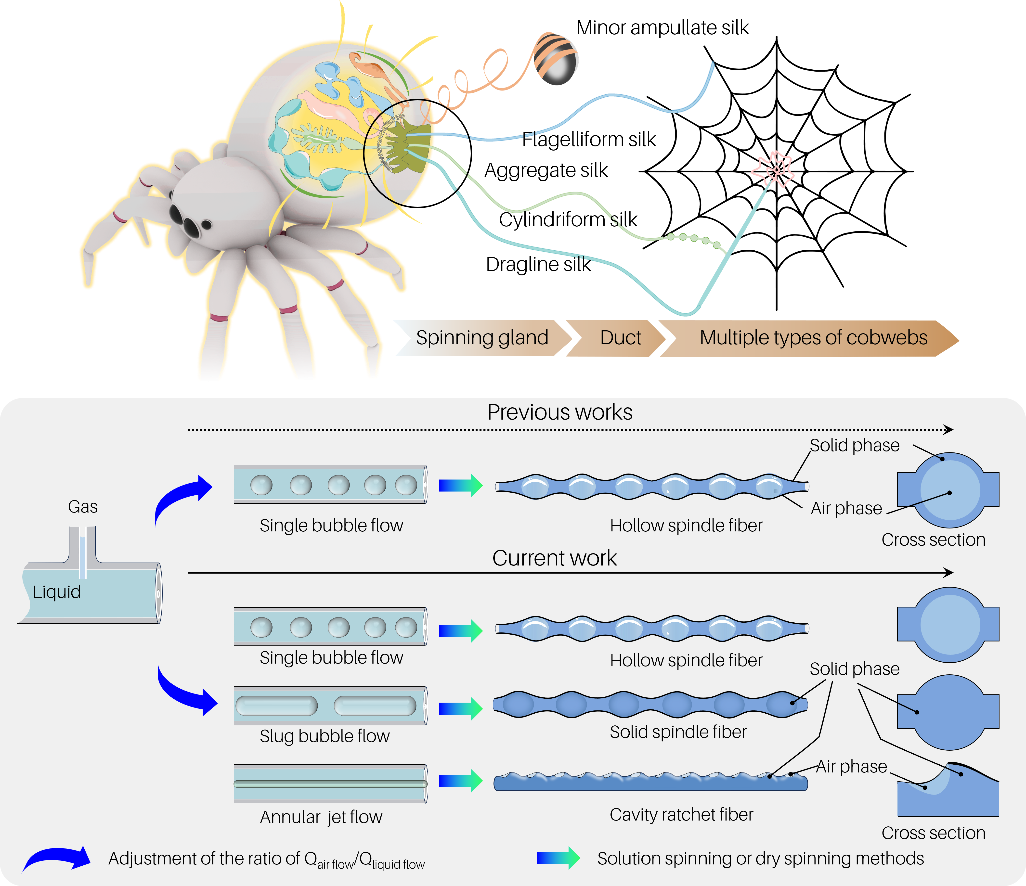
(Comparison between spider multimodal spinning/this technology and previous work)
The resulting smart fibers combine excellent flexibility and mechanical compliance. Their surfaces display asymmetric wettability and efficient moisture-transport properties. The hollow spindle-knot fibers significantly enhance hydrovoltaic power generation by retaining moisture, while the cavity-ratchet fibers, with their directional transport characteristics, are highly sensitive to subtle humidity variations such as those caused by respiration. Experimental results demonstrate that the fibers can rapidly respond to microenvironmental humidity fluctuations and continuously output stable hydrovoltaic energy, endowing wearable sensors with self-powered capability.
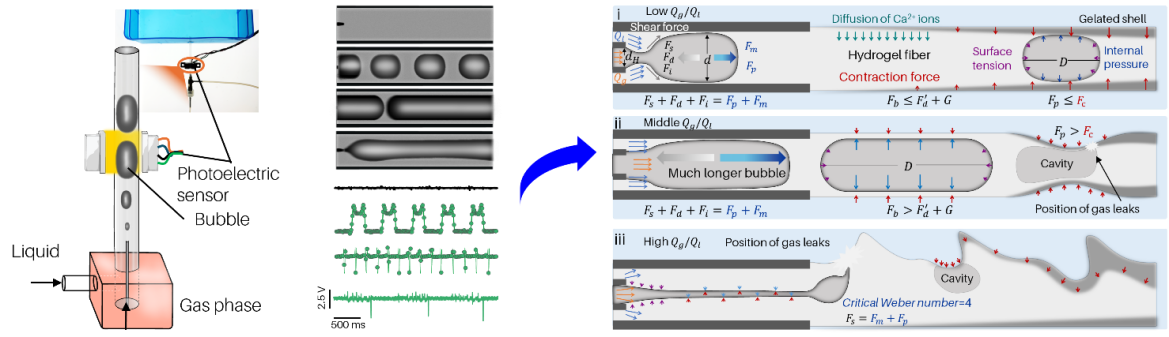
(From gas-liquid two-phase bubble flow to dynamic regulation of fiber interface configuration)
Focusing on biomedical applications, the research team demonstrated the potential of smart fibers for wearable respiratory monitoring systems. By integrating e-fiber sensing elements into a 3D-printed mask, they realized real-time detection of various respiratory states. Furthermore, they developed an integrated monitoring, diagnosis, and treatment system consisting of a signal acquisition unit, signal processing and control unit, wireless transmission module, and feedback unit. The system wirelessly transmits respiratory signals to mobile devices or computers for remote diagnosis and intelligent intervention. The smart mask conforms closely to the wearer’s face, while the fiber sensing units are mounted in replaceable multi-chamber structures. In testing, the system successfully distinguished and recorded breathing patterns such as normal respiration, post-exercise breathing, and Obstructive Sleep Apnea–Hypopnea Syndrome (OSAHS).
This work not only breaks through long-standing limitations in traditional fiber fabrication but also establishes a new paradigm for structurally programmable smart textiles and biomimetic medical materials. The method has also been successfully applied to diverse spinning systems—including sodium alginate, carboxymethyl cellulose, and poly(vinyl alcohol)—demonstrating broad versatility and scalability. It lays a theoretical and technical foundation for developing flexible hydrovoltaic energy sources and multi-field coupled sensing platforms.
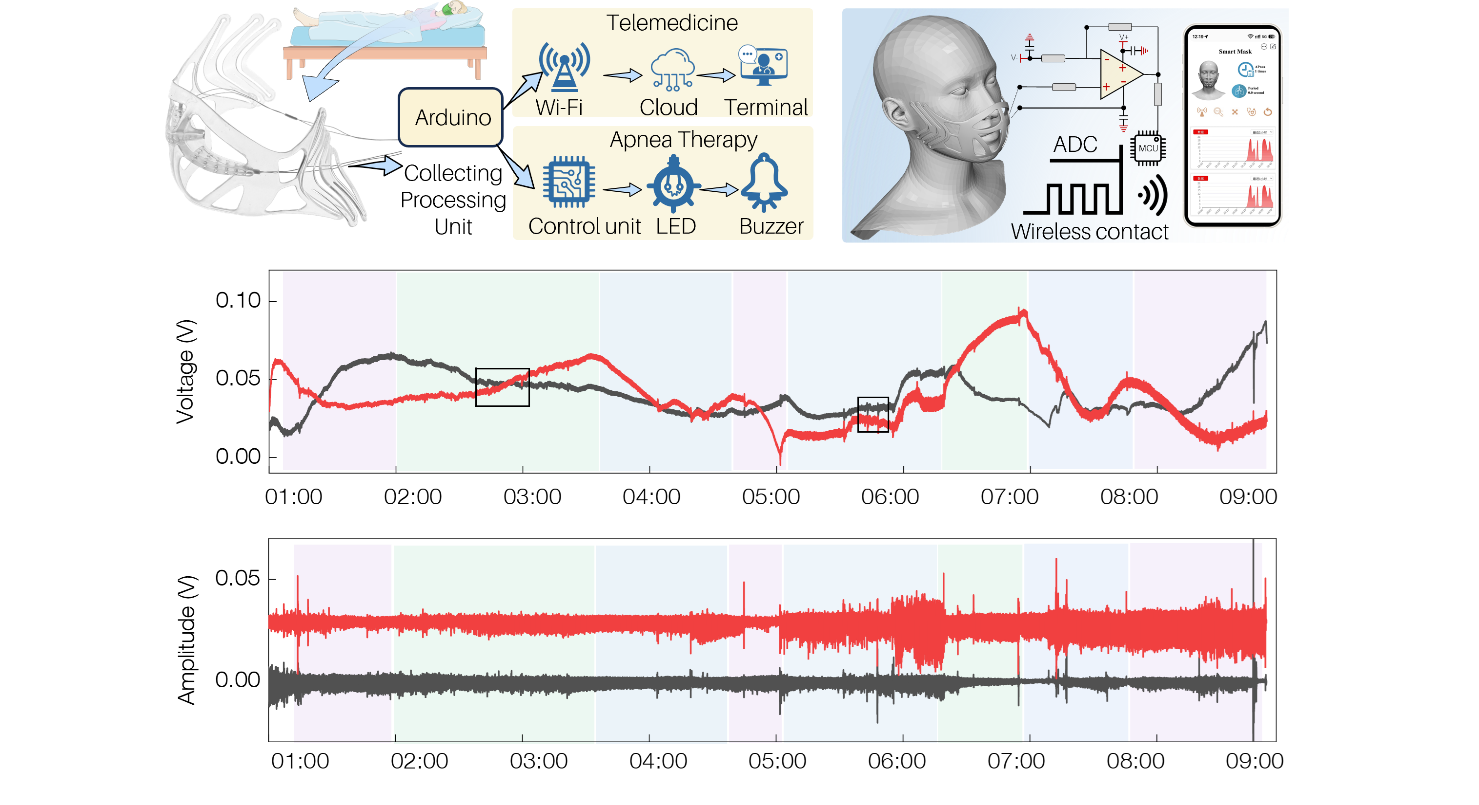
(Respiratory monitoring mask and telemedicine system)
The corresponding authors of this research are Professor Liu Xuanyong and Associate Researcher Qiu Jiajun, with Cao Yuanming, a doctoral student from the School of Biomedical Engineering at DHU, as the first author. This work was supported by the Fundamental Research Funds for the Central Universities and key projects of the State Key Laboratory of Advanced Fibers and Polymer Materials, and related patents have been filed.
Read the full paper: https://www.nature.com/articles/s41467-025-59585-6