

The Organic Fluorine Chemistry Research Team from the School of Chemistry and Chemical Engineering has recently published a review article entitled “Nitrogen-Based Organofluorine Functional Molecules: Synthesis and Applications” in Chemical Reviews, a world-renowned academic journal with an impact factor of 51.5.
Fluorine-containing compounds have been widely applied in both pharmaceutical and materials science; However, the introduction of fluorine atoms or fluorine-containing groups typically necessitates the employment of specific fluorine-containing reagents or building blocks. In recent years, the Organic Fluorine Chemistry Research Team of Donghua University has attained a series of research breakthroughs in the development and application of nitrogen-linked fluorine-containing reagents, encompassing N–F reagents (Angew. Chem. Int. Ed. 2015, 54, 11839; Org. Lett. 2020, 22, 5451; Chin. J. Chem. 2022, 40, 2965; J. Am. Chem. Soc. 2023, 135, 23899), N–Rf reagents (J. Am. Chem. Soc. 2022, 134, 1962; Chem. Commun. 2022, 58, 1346), N–ORf reagents(Angew. Chem. Int. Ed. 2021, 60, 22915; Org. Lett. 2022, 24, 9332; J. Org. Chem. 2023, 88, 4434) and N–SO₂Rf reagents (Angew. Chem. Int. Ed. 2018, 57, 6926; Org. Lett. 2021, 43, 346), among others.
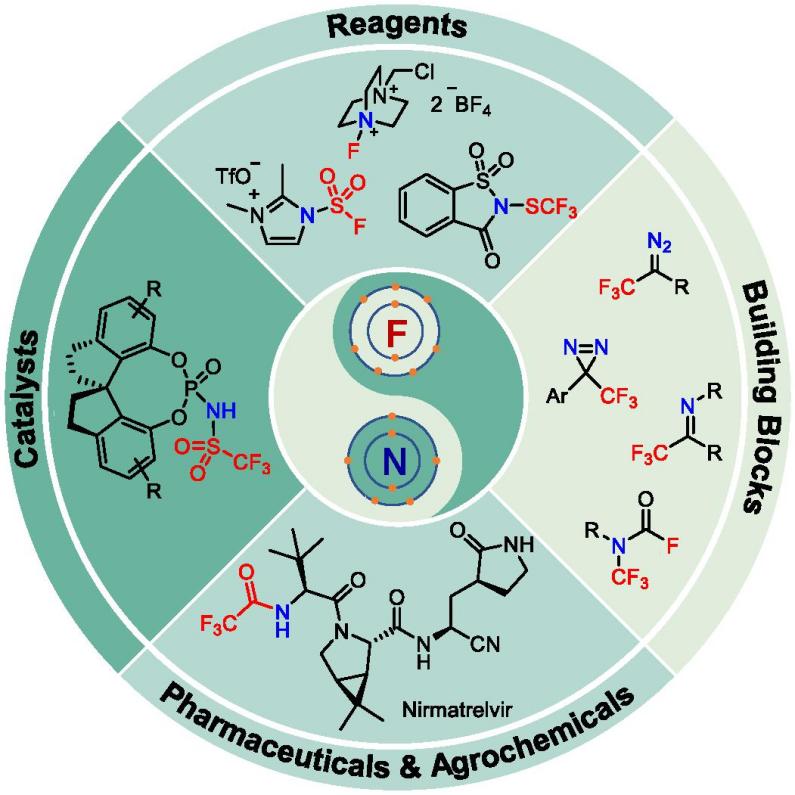
Building upon these achievements, the team collaborated with Professor Norio Shibata’s group from Nagoya Institute of Technology (Japan), Professor Xue Xiaosong’s group from the Shanghai Institute of Organic Chemistry, Chinese Academy of Sciences (CAS), and Professor Liu Guokai’s group from Shenzhen University to jointly compile a comprehensive review on recent advances in fluoro-nitrogen chemistry (Chem. Rev. 2025, DOI: 10.1021/acs.chemrev.4c00661). The review systematically summarizes over 200 widely applied fluoro-nitrogen functional molecules, categorized into four domains: reagents, building blocks, catalysts, and pharmaceutical molecules. It provides an in-depth discussion of their structure–property relationships, as well as a summary of future development trends and key challenges in the field.
Dr. Liu Shuai and Dr. Liu Yingle (doctoral graduates of Donghua University), Dr. Zhou Jun from Nagoya Institute of Technology, and Dr. Yu Lu from the Shanghai Institute of Organic Chemistry, CAS, are listed as co-first authors. Associate Professor Huang Yangen from Donghua University, Dr. Ouyang Yao and Associate Researcher Xu Xiuhua from the Shanghai Institute of Organic Chemistry, CAS, Professor Liu Guokai from Shenzhen University, and Professor Norio Shibata from Nagoya Institute of Technology serve as co-corresponding authors. Donghua University is recognized as the first corresponding unit of the paper.
Read the full paper: https://doi.org/10.1021/acs.chemrev.4c00661