

Tensile properties and processability are two crucial characteristics of polymers. There is often a trade-off between high-tensile properties and processability, making it difficult to enhance both simultaneously. Cross-linking is an important means to improve mechanical performance; however, it also restricts the plasticity of polymers, making them difficult to process. In recent years, researchers have developed covalent adaptable networks (CANs), in which dynamic covalent bonds can reorganize under appropriate stimuli (such as heat, light, etc.). This design enables cross-linked polymers to be reprocessed. However, as the cross-link density increases, the processing of CANs generally becomes more challenging, failing to fundamentally resolve the inherent contradiction between mechanical performance and processability.
Faced with this challenge, a research team led by You Zhengwei,from the State Key Laboratory of Advanced Fiber Materials and theCollege of Materials Science and Engineering at DHU, has proposed a strategy of using a four-arm dynamic chemically coupled cross-linker to construct the polymer molecular network. Researchers propose a molecular strategy for constructing polymers using four-arm dynamic chemically coupled cross-linking units to establish an paradigm-shifting structure-property relationship where processability is improved with increasing cross-link density. The key to the structure design is the tetrafunctional cross-linker diaminoglyoxime (DAG), where two oxime and two amino groups can react with isocyanates to generate dynamic covalent oxime-carbamate bonds and dynamic covalent amidine-urea bonds rich in hydrogen bonds, thus constructing a cross-linking network integrated with triple dynamic bonds (Fig.1).
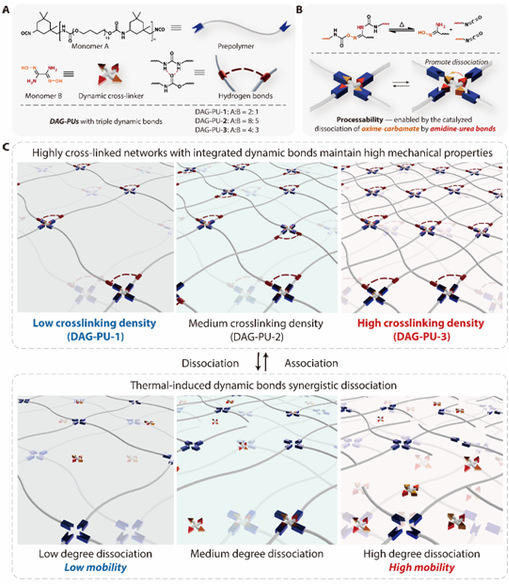
Fig. 1. Structure design of DAG-PU elastomers for simultaneously improving processability and mechanical performance.
The study demonstrates that increasing the cross-link density significantly enhances the mechanical properties of the material at room temperature. Meanwhile, thanks to the design of the four-arm dynamic cross-linking site and the presence of a higher content of dynamic bonds, polymers with high cross-link density dissociate more readily into low–molecular weight segments at elevated temperatures, reducing viscosity and exhibiting better processability. The previously discovered mechanism of chemically mediated association through endogenous catalysis (Proc. Natl. Acad. Sci. U.S.A. 2024, 121, e2404726121.) also plays a key role in this system. This simultaneous enhancement of cross-link density and high-temperature fluidity challenges conventional understanding and offers a new molecular design strategy to resolve the trade-off between mechanical properties and processability in polymers.
This research proposes a molecular design strategy based on chemically coupled four-arm dynamic cross-linking, in which polymers with higher cross-link density exhibit improved mechanical properties and processability—contrary to the conventional structure–property relationship—thus providing a new approach to overcoming the conflict between mechanical performance and processability in polymers. The study shows that the outstanding mechanical properties of the elastomer originate from the high cross-link density and the microphase separation structure promoted by hydrogen-bond-rich amidine-urea segments, which also confer excellent creep resistance and damping behavior. Its good processability is attributed to the increased content of dynamic bonds resulting from the higher number of dynamic cross-linking points, as well as the catalytic effect of the amidine-urea bond on the oxime-carbamate bond. Moreover, the material achieves thermally triggered self-healing and reshaping, with mechanical property recovery rates exceeding 90%. This molecular design strategy integrating electronic effects and topological structures provides a new paradigm for developing next-generation polymer materials that are high-performing and easy to process.
Paper Link: https://www.science.org/doi/10.1126/sciadv.adt0825