

Recently, the research team led by Researcher Cai Dongqing from the College of Environmental Science and Engineering has made significant progress in the one-hour humification and fertilizer utilization of Enteromorpha prolifera (EP), a marine solid waste. The findings were published in the international journal Nature Communications (2025) 16: 5860. Donghua university is the first corresponding author institution.
In recent years, due to intensified marine eutrophication, frequent outbreaks of Enteromorpha prolifera(EP) have led to large-scale “green tides”, severely impacting coastal fisheries, shipping, and water quality. Current disposal methods, such as composting and landfilling, suffer from long processing cycles, inefficient resource utilization, and risks of secondary pollution. Efficient, eco-friendly disposal and resource utilization of EP have become critical challenges in environmental protection.
The team developed a novel decomposition agent that achieves one-hour humification of EP under ambient temperature and pressure, producing a bio-fulvic acid fertilizer (OEPF). The key to this technology lies in utilizing free radicals to degrade and polymerize organic matter such as polysaccharides and proteins in EP, forming highly bioactive fulvic-like acid (FLA). Pot and field experiments demonstrated this new fertilizer significantly promotes plant growth and root development. Compared to traditional seaweed composting and mineral-derived FLA fertilizers, this technology lowers production costs, saves more energy and prevails in environment protection, providing a green, low-cost solution for efficient EP recycling.
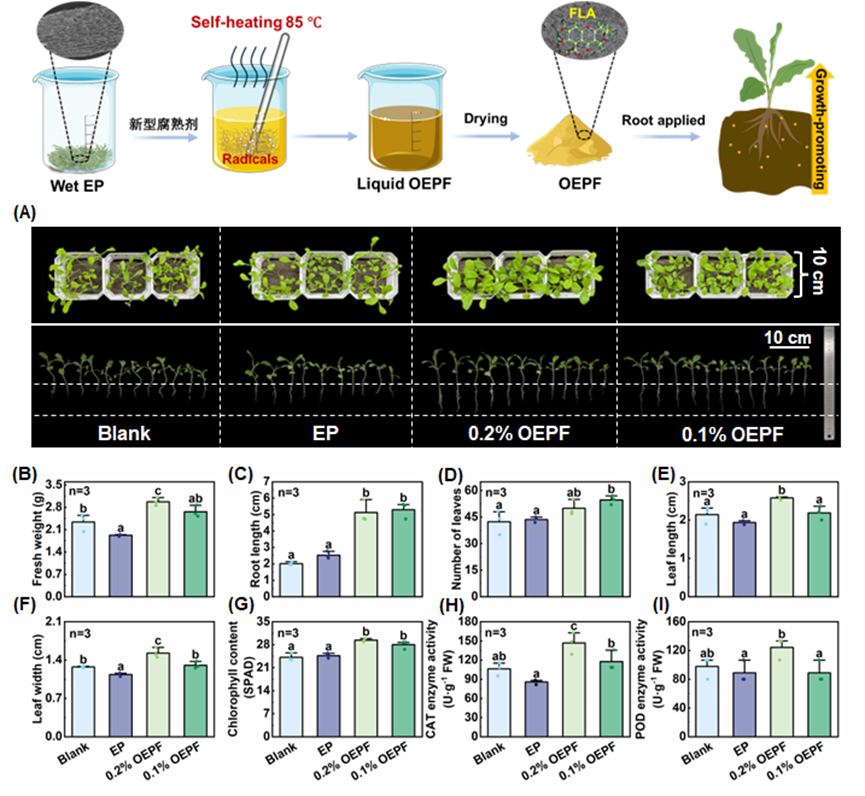
(Principle and effects of the one-hour Enteromorpha decomposition technology)
China generates approximately 4 billion tons of livestock manure, 1 billion tons of straw, and 120 million tons of food waste annually. Traditional composting methods face three major challenges: long cycles (30-60 days), low efficiency (fulvic acid content of only 1%, with organic fertilizer application rates of 1-2 tons per acre), and incomplete sterilization (heavy metal and harmful bacteria removal rates typically below 70%). These issues hinder China’s progress in dual-carbon goal and rural revitalization.
Supported by projects such as the National Natural Science Foundation of China(NSFC), the team pioneered a rapid decomposition theory based on “high-yield free radicals induced degradation-polymerization via nano-decomposition agents.” They innovatively developed a one-hour nano-decomposition agent for organic solid waste, along with self-heating, ultra-high-temperature, and directional humification technologies, establishing an in-situ deep detoxification system for heavy metals and harmful bacteria. This technology can self-heat materials to over 80°C in 10 minutes and convert them into fulvic acid-type organic fertilizer within one hour.
Compared to traditional composting, the disruptive advantages of this technology include:
1) Reducing the decomposition cycle from 30 days to 1 hour (720-fold efficiency improvement);
2) Increasing fulvic acid content to 3-9% (compared to nearly 1% in traditional organic fertilizers);
3) Achieving deep detoxification: over 98% heavy metal passivation and complete elimination of harmful bacteria. Additionally, it saves 70% in space and labor while reducing carbon emissions by over 30%.
The technology has obtained four invention patents and has been licensed to six Chinese companies. A 250,000-ton rapid-decomposition organic fertilizer production line has been established. The fast-decomposition fertilizer has been applied to over 500,000 acres, increasing crop yields by 15-50% compared to the effect of traditional organic fertilizers, reducing chemical fertilizer use by over 50%, and generating economic benefits exceeding 40 million yuan.
The achievements have received multiple awards, including the National Disruptive Technology Innovation Competition Excellence Award, Shanghai “Gathering Global Talents” Global Innovation and Entrepreneurship Competition Excellence Award, Shanghai High-Value Patent Operation Competition Benchmark Award (Top 3) and Best Transaction Award, and the National Challenge Cup Silver Award. They were also selected as one of the top 10 cases of youth innovation and entrepreneurship in Shanghai’s Songjiang District in 2025. Key mechanisms were elucidated in two Nature Communications papers.
This technology is expected to transform organic fertilizer production from “inefficient, smelly, and low-quality” to “fast, eco-friendly, and high-quality”, effectively supporting China’s development in rural revitalization and the dual-carbon goal.
Paper link: